wstETH Is now One Click away. Here's What Made It Possible.

Lido's staked ETH holds over $20B in TVL, demand that has held steady across several market cycles. But for users starting on different chains, getting there still means multiple steps. The demand is proven, but the path could be simpler.
A user holds ETH on Arbitrum and wants wstETH on Arbitrum. Today, that means opening a DEX, swapping into wstETH, and incurring slippage; or waiting 1 week to bridge back to Ethereum, staking it to stETH, wrapping it to wstETH, and bridging back to Arbitrum. All these hoping nothing fails silently along the way.
Many apps.
Multiple signatures.
Much dead time between steps.
LI.FI, Lido and Chainlink have now streamlined the entire sequence into a single click. ETH on Arbitrum in, wstETH on Arbitrum out. One transaction. One signature.
Chainlink's Cross-Chain Interoperability Protocol (CCIP) enables this capability by powering direct staking solutions that let users stake L1 assets (e.g., ETH) from layer-2 networks and receive a liquid staking token (e.g., wstETH) directly on the same layer-2 network in a single transaction. Cross-chain security is provided by the same battle-tested infra that has securely enabled over $28.6 trillion in transaction value.
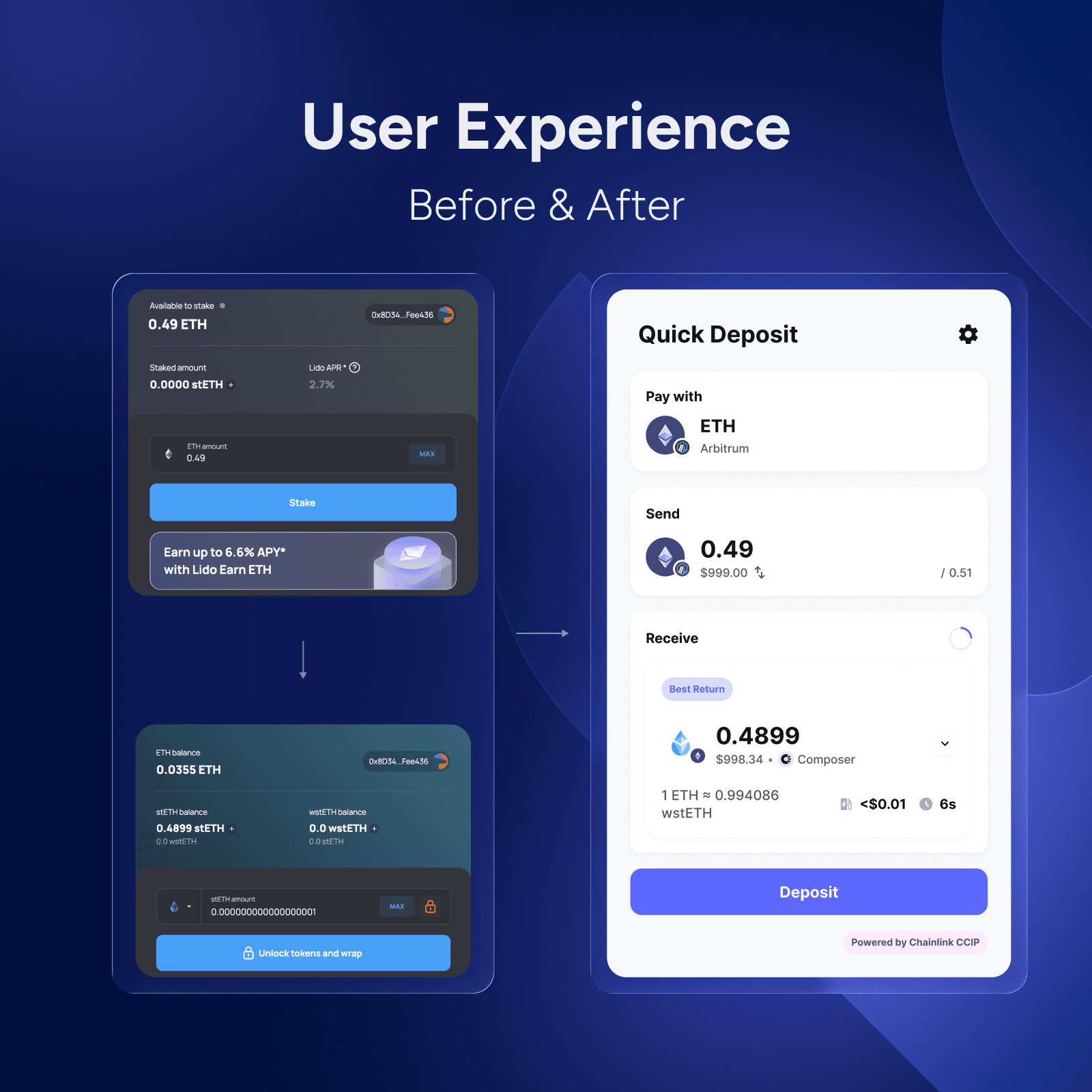
How does it actually work?
Most cross-chain tooling today either bridges assets or routes swaps. Both treat each action as a discrete step. The developer or user is still responsible for sequencing steps, handling intermediate states, and managing failures between them.
For the wstETH route, the underlying infrastructure handle distinct layers to simplify this process into a seamless, native staking UX:
LI.FI: Acts as the order router widget allowing users to access wstETH instantly on supported L2s by retrieving price quotes directly from the API. This makes Lido's wstETH immediately available to a vast number of users and enables cross-chain staking natively on the L2 without requiring gas on Ethereum.
Custom Quote API: Built on top of Chainlink's direct staking suite of contracts, this interface returns price and routing information in an aggregator-friendly way, enabling seamless integration within LI.FI.
Chainlink CCIP: Operates on the backend to securely bridge wstETH, WETH, and ETH between mainnet and remote chains. Its architecture separates validation from execution, so a failure in delivery doesn't leave assets in limbo.
Chainlink Automation: Powers the FastStaking feature by continuously rebalancing pools. This allows for the atomic swapping of ETH for wstETH at the exact same rate as mainnet.
Lido: Powers the staking leg, producing the final wstETH output once assets arrive in the correct form.
The Bigger Picture
The integration between LI.FI, Chainlink, and Lido demonstrates what DeFi composability looks like when protocols build together rather than in isolation.
Chainlink brings the highest level of cross-chain security. Lido brings the deepest liquid staking liquidity in the space. LI.FI brings the bridge aggregator that ties them together and makes it accessible through a single API, distributed across wallets and frontends like Jumper, MetaMask, Rabby, Phantom and more.
Three protocols, each best-in-class in their layer. One API call to use all of them together.
This is how the next generation of DeFi gets built.
Developers building cross-chain flows can access this route today through the LI.FI API, or explore it live on Jumper Earn.
Disclaimer:
This article is only meant for informational purposes. The projects mentioned in the article are our partners, but we encourage you to do your due diligence before using or buying tokens of any protocol mentioned. This is not financial advice.