Brazil: The Next Frontier for Prediction Markets


Brazil represents the most asymmetric market opportunity of the next decade for prediction markets. A unique convergence of factors suggest it's a largely untapped market:
a population of 25 million digital bettors ~$8billion in monthly crypto transaction volume
a newly established regulatory environment
Together, these create a serviceable market opportunity exceeding $100B annually, ready to be captured.
This document argues that Brazil is not just a potential market for prediction markets, but rather the catalyst that can transform event trading from a derivatives niche into a global asset class. We analyze the three pillars of this opportunity, human capital, financial capital, and market timing, and outline a strategy to establish Brazil as the world's leading hub for prediction markets.
Key Takeaways:
Brazil is the most asymmetric near-term opportunity for prediction markets globally, with a >$100B serviceable market already primed for event-based trading.
Scale is already proven. Brazil is the 5th largest betting market globally (USD ~$4.1B GGR) with ~25M bettors.
Demographics and a culture of speculative behaviour strongly favor adoption. Gen Z and Millennials drive both crypto (+56% YoY under 24) and online betting (+135% YoY), making them natural early adopters of event trading.
Crypto provides ready-made financial rails. Brazil is the 5th largest crypto adoption market worldwide, moving USD 6–8B monthly, ~90% via stablecoins.
There is a clear product vacuum. No regulated Brazilian platform currently offers price discovery, trading mechanics, and non-sport event contracts, creating a decisive first-mover advantage.
1. Cultural Genesis: The Digitalization of Risk
Brazil's inclination toward gambling has a lineage that stretches back to the late 19th century, when the Jogo do Bicho emerged in Rio de Janeiro. Conceived in 1892 by the Baron of Drummond as a way to fund the city's zoo, the game quickly drifted from its institutional purpose and evolved into a ubiquitous informal lottery. Its power lay not in legality or scale, but in its organic integration into the daily lives of urban and peripheral communities. Built on mutual trust and a symbolic system of animals that translated chance to meaning, Jogo do Bicho democratized access to financial speculation for segments of the population long excluded from formal banking and investment systems.
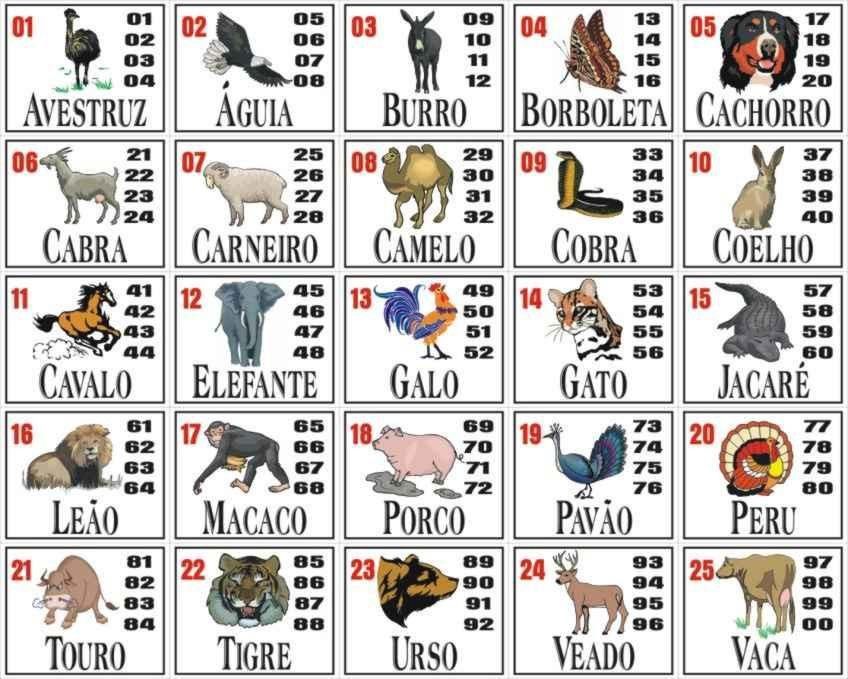
In doing so, it did more than normalize gambling. Jogo do Bicho introduced fundamental concepts of risk management that are now central to financial markets. The "bicheiros" functioned as informal market operators, setting odds, managing exposure, and pricing future events. A Jogo do Bicho bettor, even without financial training, internalized principles such as the relationship between probability and return, the importance of diversifying bets, and bankroll management. This "informal university of risk" laid the groundwork for the sophistication that would come with the digital age.
Despite being formally classified as a criminal offense for decades, Jogo do Bicho established what can be described as collective "risk literacy." It normalized the idea that random events or outcomes of complex systems could be subject to monetary gain, creating a network of "bicheiros" who effectively operated as the first local prediction market operators. This cultural foundation is key to explaining why the country's transition to digital sports betting was so seamless: Brazilians did not need to learn how to gamble; they only needed a technological interface that brought betting tips to the palm of their hand.
Today, the omnipresence of betting houses is unmistakable: they dominate prime-time television, sponsor high-audience podcasts, and, fundamentally, shape the economic fabric of professional football. With this consolidated cultural base, Brazil witnessed an unprecedented transformation when digital technology met the tradition of speculation through digital means.

2. Brazilian Market: Volume and Penetration Metrics
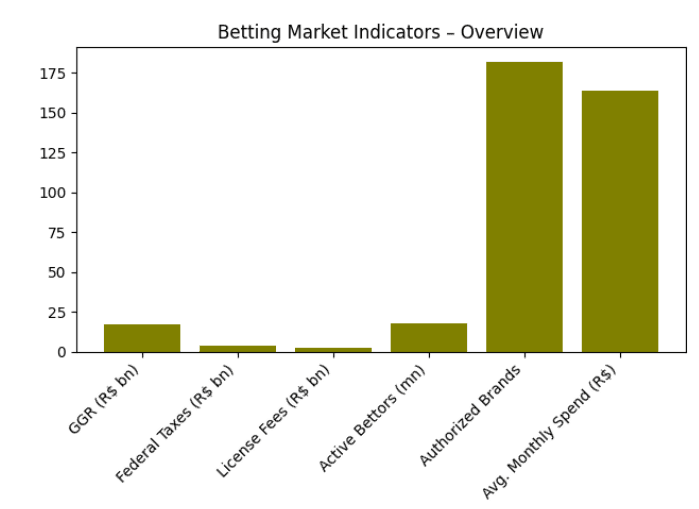
The figures emerging from the Brazilian landscape in 2025 are difficult to ignore. They consolidate the country as the fifth-largest betting market in the world in terms of estimated net revenue. Transaction volumes and the number of active users reveal a sector that is no longer a niche for enthusiasts but a structural component of the service and entertainment economy.
According to data from the Secretariat of Prizes and Bets, authorized operators generated a Gross Gaming Revenue (GGR) of BRL 17.4 billion (approximately USD 3.14 billion) in just the first half of 2025. GGR, defined as total bets minus prizes paid out, is the industry's clearest signal of profitability and market health. In Brazil, this figure is underpinned by a remarkably large and engaged user base: roughly 25 million Brazilians placed bets on regulated platforms during the same period.
3. Global Comparative Analysis
To properly gauge the opportunity that Brazil represents for prediction markets, it is important to compare its trajectory with that of international markets. Comparison, in this case, is clarifying: it reveals not just scale, but timing.
The United States offers the most instructive recent parallel. Following the repeal of the federal ban in 2018, the United States established itself as the fastest-growing sports betting market in the world. In 2024, the total amount wagered (handle) reached USD 149.9 billion, generating USD 13.78 billion in gross revenue for operators, an annual growth of 24.8%. The sector is characterized by regulatory fragmentation across states, with 38 jurisdictions already legalized; New York stands out as a leader in volume (USD 22.7 billion) and tax collection, exceeding USD 800 million annually in taxes.
Across the Atlantic, in the United Kingdom and Europe, the market shows greater maturity and regulatory structure. The UK's GGR totaled €30.8 billion in 2023, with a strong predominance of the online segment (€11.1 billion), while the European GGR reached €123.4 billion in 2024, with a projected annual growth rate of 5%. These markets illustrate what betting ecosystems look like once penetration stabilizes and operators shift their focus from user acquisition to retention, efficiency, and product differentiation.
Online gambling penetration varies significantly between countries, exceeding 68% in markets such as Sweden and Denmark, but remaining limited in Spain, where it accounts for only 14.2% of total revenue. In the Asia-Pacific region, the market was valued at USD 92.34 billion in 2024, maintaining strong concentration in land-based casinos, with Macau as the main global hub, while the online segment grows at an annual rate of 9.45%, still constrained by regulatory challenges, particularly in China.
Seen against this global backdrop, Brazil occupies a distinctive position: a large, digitally native population, a newly regulated market, and a cultural familiarity with speculation that resembles the early U.S. inflection point, yet without the same degree of regulatory fragmentation. This combination is what makes Brazil less a late entrant and more a market on the cusp of its own accelerated phase.
Brazil's GGR already surpasses most individual European markets, ranking 5th globally behind the United States ($17.3B), United Kingdom ($9.9B), Italy ($4.6B), and Russia ($4.5B) — even while still in the early stages of full regulation.
Brazil's true differentiator lies in its almost entirely digital and mobile user base, which eliminates the friction of physical infrastructure and accelerates the adoption of new financial and entertainment products, such as event contracts in prediction markets.
4. The Golden Intersection
The Brazilian landscape in 2025 reveals a statistical alignment without global parallel: the country has simultaneously consolidated its position as the 5th largest betting market in the world in terms of estimated net revenue (GGR) and the 5th country in the Global Crypto Adoption Index according to Chainalysis.
Brazil ranks 5th in the Chainalysis Global Crypto Adoption Index — notably consistent across every sub-category (retail, institutional, centralized, and DeFi) — behind only India, the United States, Pakistan, and Vietnam.
This convergence indicates that Brazil is not merely a consumer of digital entertainment, but a hub of financial and speculative innovation. While passion for football drives the betting handle toward projected annual figures of over $24 billion, the crypto infrastructure, where approximately 90% of flows already occur via stablecoins, provides the technological rails required for the instant and global settlement that prediction markets demand.
Prediction markets emerge as the next step in the sector's sophistication ladder. Unlike traditional betting, prediction markets can be positioned as market intelligence and economic hedging tools, aligning more closely with consumer protection agendas and the Central Bank's financial stability objectives.
The scale of latent opportunity becomes even clearer when capital flows are compared. Considering that Brazil is the fifth-largest country in the world in terms of crypto usage according to Chainalytics, the monthly capital flow in the Brazilian crypto market, consistently between USD 6–8 billion, is 7 to 10 times larger than the monthly volume of sports betting. This disparity demonstrates an ocean of digital liquidity ready to be channeled. In 2025, approximately 90% of crypto volume in Brazil is composed of stablecoins (USDT/USDC). This removes the volatility barrier, functioning as an ideal 'transactional TVL' for the instant settlement that prediction markets require.
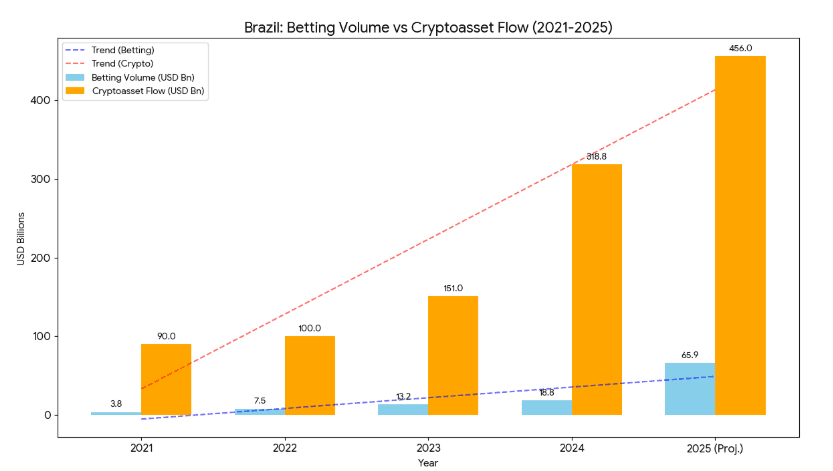
We must also consider the user profile that engages with the crypto market and prediction markets. The 56% growth in the participation of crypto investors under 24 years old in 2025 directly coincides with the age group that drove a 135% increase in online betting during the same period.
Crucially, these audiences overlap: the 56% growth in crypto investors under 24 in 2025 directly coincides with the age group driving a 135% increase in online betting — making Gen Z and Millennials natural early adopters of event trading, while Gen X and Baby Boomers offer higher-value institutional and hedging liquidity.
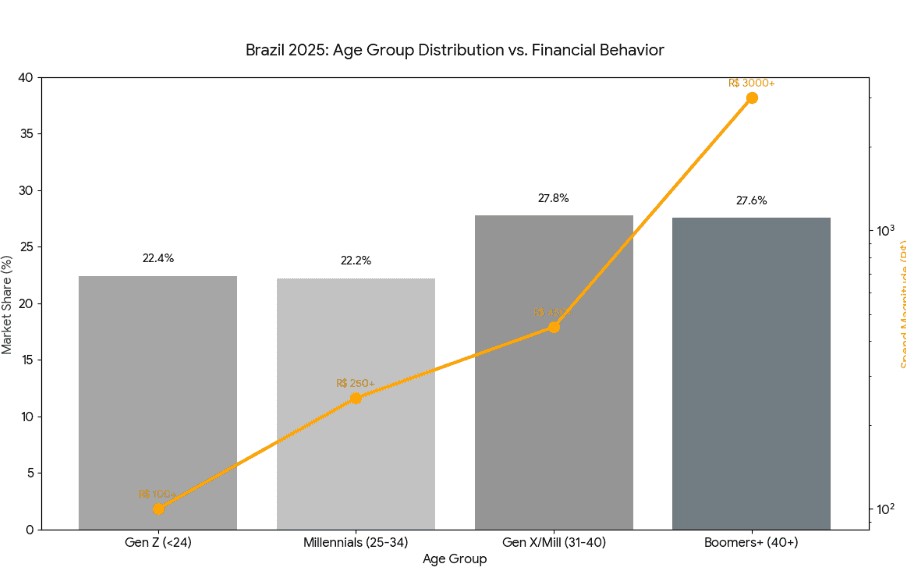
What distinguishes Brazil further is the evolving behavior within its crypto market itself. While traditional betting focuses on leisure, the Brazilian crypto market is shifting toward structured investments (over 18% of users diversify portfolios in 2025). This behavior is the perfect precursor for "Event Trading," where users not only "bet" but also hedge and arbitrage information.
Finally, the expansion of prediction markets in Brazil will also depend on the reconfiguration of the digital influence ecosystem. Prediction markets, by their analytical nature, favor data- and insight-driven marketing, which can attract a new type of user—closer to stock market investors than to compulsive slot gamblers.
5. The Opportunity Gap
A comparison between the volume of sports betting in Brazil and the volume generated by global prediction markets reveals a massive strategic gap. Brazilians already spend billions on betting, but almost entirely on binary fixed-odds formats. There is currently no large-scale domestic platform that employs trading mechanics and price discovery for non-sporting events.
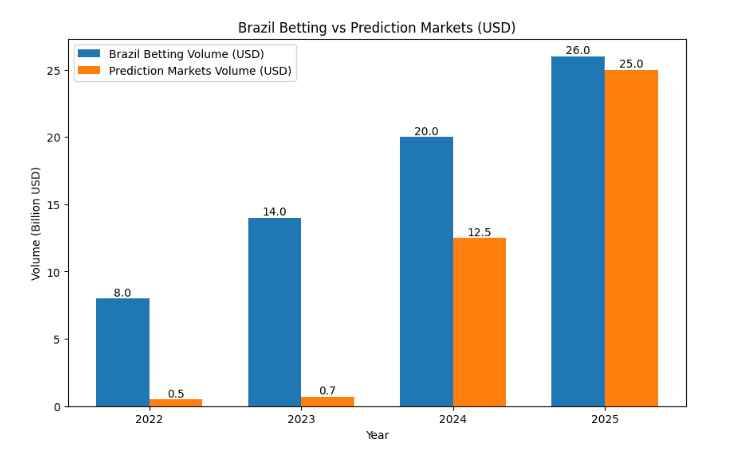
This identified gap stems from the fact that prediction markets have not yet been "Brazilianized." While leading prediction market platforms focus heavily on U.S. politics and economics, Brazil offers a universe of local events, from fluctuations in agricultural commodity prices to congressional votes. There are three key pillars for the expansion of prediction markets in Brazil.
The potential of prediction markets in Brazil manifests across three complementary fronts: in corporate hedging, Brazilian companies face significant risks associated with climate and regulatory decisions, which could be mitigated through contracts traded on prediction market platforms. In financial education via gamification, Brazilians already view betting as a form of "investment," and prediction markets offer a natural transition to a more sophisticated trading model, with tighter spreads and real-time price discovery. Finally, there is a clear competitive vacuum, as there is currently no regulated structure in Brazil that combines derivative mechanics with the intuitiveness of event-based markets, creating a clear first-mover advantage opportunity for players like Kalshi or Polymarket.
However, the average Brazilian user does not fit the classic profile of the European recreational bettor or the American retail trader. He is a hybrid: a "speculative investor" who already uses Betano to monetize his sports knowledge and Binance to gain exposure to global risk assets. He does not fear volatility; he seeks it. For this user, a prediction market is not a complex hedging tool; it is the natural evolution of his behavior — a platform that offers the same adrenaline of betting but with the sophistication, transparency, and return potential of the financial market.
Contrary to common perception, regulatory uncertainty in Brazil is a competitive advantage for a well-prepared prediction market entrant. Law 14,790 established a floor for operations but left the ceiling open. The jurisdictional battle between the CVM and SPA allows well-positioned platforms to engage as partners in rule-setting. Entering in 2026 is not entering late; it is arriving at the exact moment to shape the market's future, establishing a regulatory moat against less-prepared competitors.
5.1 Market Analysis
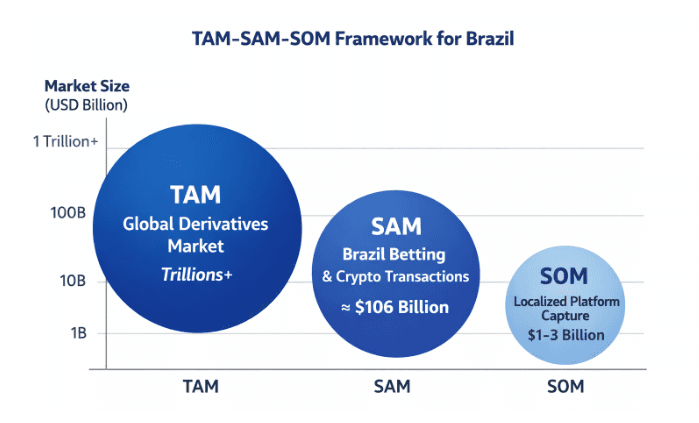
To quantify the scale of the Brazilian opportunity, we use the TAM-SAM-SOM framework, which highlights the transition from entertainment to financial instrument. The Total Addressable Market (TAM) for event trading in Brazil is anchored in the global exchange-traded derivatives market, estimated in the trillions of dollars, representing the long-term competitive arena for predictions.
More immediately, we define the Serviceable Addressable Market (SAM) as the sum of Brazil's annual betting GGR (projected at USD 5–6 billion) and the annual cryptocurrency transaction volume (exceeding USD 100 billion), resulting in an initial SAM of approximately USD 106 billion. This figure represents capital already allocated to risk-adjacent digital instruments.
Finally, the Serviceable Obtainable Market (SOM) projects that a platform entering with a robust local strategy could capture 1% to 3% of this SAM within the first three years, generating an annual trading volume between USD 1 billion and USD 3 billion. This growth trajectory would position Brazil among the most relevant global operations for prediction markets from its inception.
However, the path to expansion is not without challenges. The Secretariat of Prizes and Bets (SPA) and the CVM have not yet issued definitive opinions on how prediction markets will be classified under the new Brazilian framework.
The classification of prediction markets as financial derivatives by the CVM, rather than as "gambling" by the SPA, is not a mere bureaucratic formality. It will determine whether institutional investors, such as pension funds, family offices, and hedge fund managers, can legally allocate capital to these platforms. A classification as "gambling" would keep prediction markets as a retail product, limited to speculative capital from individuals. A classification as a derivative would open the gates to institutional capital, potentially multiplying liquidity by orders of magnitude. This regulatory decision, therefore, not only defines legality but also shapes the very growth trajectory of the sector.
If viewed purely as "gambling," they would be subject to the heavy taxation of Law 14,790; if classified as financial derivatives, they would fall under a more complex regulatory regime, but potentially with greater institutional credibility.
6. Future Outlook
The Brazilian betting market, driven by a centuries-old culture of speculation and accelerated by digital technology, has reached a maturity that positions it at a turning point. Data analysis shows that future growth will not rely solely on the expansion of sports betting volume, but on the sophistication of products offered to an already engaged audience.
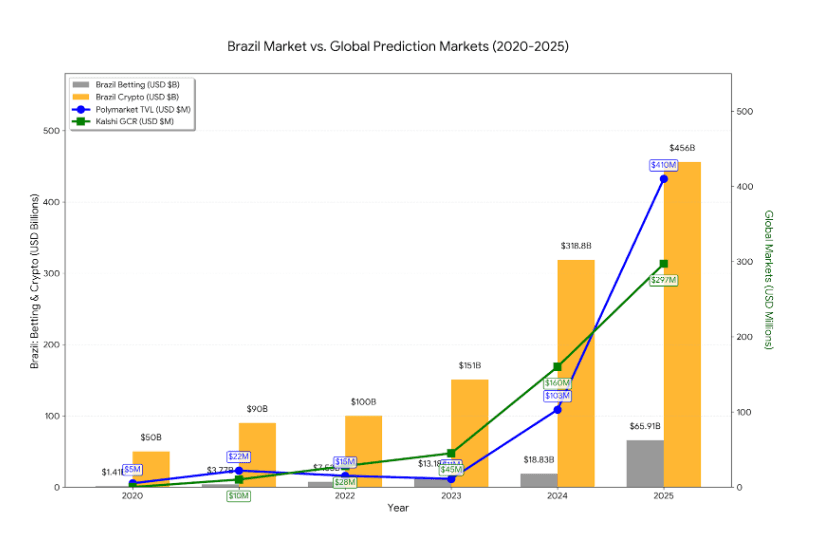
Ultimately, the Brazilian betting market is a giant that has just awakened to regulation. The opportunity gap for prediction markets is, in fact, an invitation to the sophistication of an audience that has already proven that betting is indeed in its nature. The convergence between the "wisdom of the crowds" and the financial vigor of Brazilian bets has the potential to create one of the most dynamic and precise prediction markets on the planet.
However, the thesis outlined in this research depends on one critical assumption: that capital can move seamlessly. For prediction markets to absorb the liquidity currently flowing through Brazil's betting and crypto ecosystems, the underlying infrastructure must support instant, cross-chain settlement at scale — across stablecoins, across chains, and across user contexts.
This is precisely the problem LI.FI was built to solve. As the universal liquidity protocol, LI.FI connects 60+ blockchain ecosystems through a single API, routing transactions across the most efficient pathways for cost, speed, and security. With over $80 billion in lifetime transaction volume and 1000+ integration partners, LI.FI already serves as the invisible liquidity layer behind many of the wallets and applications that Brazilian crypto users interact with daily.
For prediction market platforms entering Brazil, LI.FI eliminates the single largest technical barrier to adoption: fragmented liquidity. A user holding USDT on one chain can fund a prediction contract settled in USDC on another — without friction, without multiple wallet interactions, and without needing to understand bridging mechanics. In a market where 90% of crypto flows are already stablecoin-denominated, this user experience is a necessity.
We see prediction markets as one of the most compelling use cases for cross-chain infrastructure in the years ahead, and Brazil as the market where that thesis gets proven first. We're excited to support the platforms, developers, and builders who will turn this opportunity from analysis into reality!
Disclaimer:
This article is only meant for informational purposes. The projects mentioned in the article are our partners, but we encourage you to do your due diligence before using or buying tokens of any protocol mentioned. This is not financial advice.