Unbundling Finance Was DeFi’s Innovation. Now It’s Holding Us Back.


For me, the mental model to understand the DeFi ecosystem has always been money legos.
It's one of the cleanest ways to understand what makes DeFi fundamentally different from legacy finance
What Are Money Legos?
Most of us have played with Lego. Simple, colorful plastic bricks - a few studs on top, a few holes underneath. Each brick follows the same physical standard, which means you can snap them together and build something far greater than the individual pieces suggest.
That's the whole idea. Standardized building blocks, designed to be combined, producing outcomes their individual parts couldn't achieve alone.
To me, the beauty of Legos lies in two simple things.
1) They offer endless possibilities - the lego pieces can be combined in endless different ways, meaning your imagination is the only thing that's stopping you from building something really cool and novel with it.
2) You can piece together small lego bricks to build something truly big, something bigger than the sum of its parts. I've found that the best systems in the world tend to work this way. They produce lollapalooza effects.
The fact that you can piece together something as magnificent as Old Trafford…
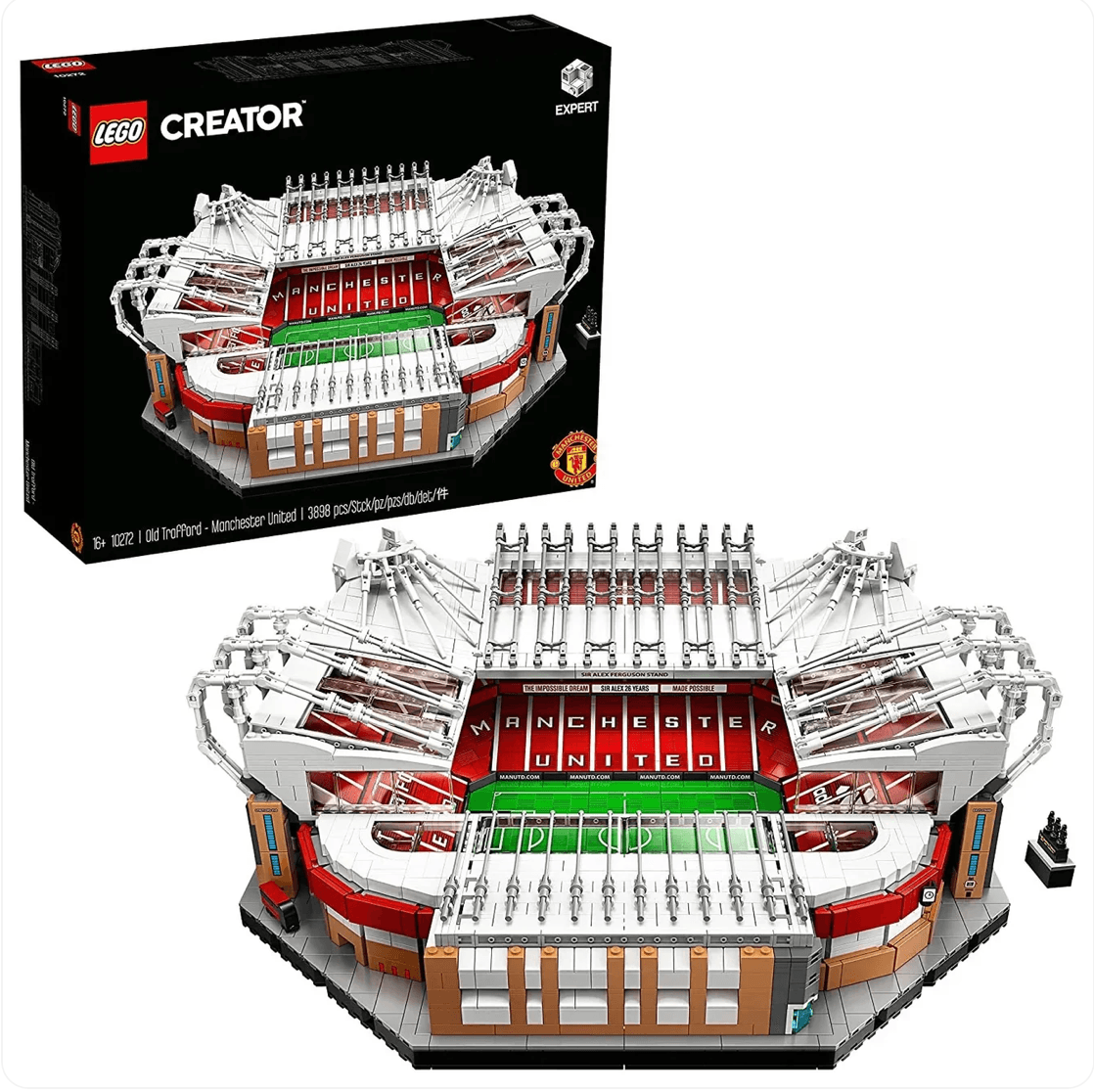
…with just a bunch of colorful plastic bricks like this, is remarkable, to say the least.

Crypto borrowed this metaphor early and called it money legos. In DeFi, money legos work the same way - because blockchains and smart contracts enforce the same kind of standardization that makes Lego bricks snap together:
Blockchains act as the base layer on which all these legos sit. Vitalik called Ethereum the lego of crypto-finance back in 2014 - the base sheet on top of which everything else fits together. That's the opposite of traditional finance, where each institution runs its own private database and you can't build on what others have already done.
Smart contracts codify rules directly into value, adding programmable logic that lets money legos interact with each other without permission — allowing builders to build on each other's work.
In effect, money legos allow us to build on the progress of others in DeFi.
Instead of starting from raw materials every time, builders start with fully assembled Lego pieces–DEXs, bridges, lending protocols–and use those as building blocks to create something new.
Which effectively means instead of starting from this:

Builders start with fully assembled lego pieces built by other builders as building blocks, starting from this to build new cool things:

This is what separates DeFi from legacy finance. DeFi is the unbundled form of finance; unbundled into open and composable money legos that can be permissionlessly combined with one another. You can build on the progress of others. Legacy finance lives in walled gardens. Data is private, access is limited, and the pieces don't fit together.
Once you really grok this, it becomes clear that this is where DeFi's real power comes from: composability.
And the Lego metaphor really clicks when you look at the definition of composability itself:
"Composability is the property that lets independent pieces of a system be combined into something new without either piece needing to be redesigned."
At LI.FI, we've started to think about the crypto ecosystem as the universal market for global finance. Blockchains are the rails that will inevitably house all of finance. And when you step back and ask what makes a universal market possible, it's composability. Composability is the reason DeFi can produce outcomes greater than the sum of its parts: each protocol is open by default, so anyone can stack them.
When money legos can be freely combined, they give rise to DeFi primitives - the actions we perform in crypto: swap, bridge, deposit, stake, buy. Each one is just a particular sequence of money legos slotted together. Much like how all those individual pieces eventually come together to form the Old Trafford Lego set.
In DeFi, every protocol is a Lego. A DEX is a Lego. A bridge is a Lego. A lending protocol is a Lego. Each one is a building block that can be combined with others to create something new, something greater than the sum of its parts. In this case, that something is a financial system with no walls – where any builder can create, and any user can access, without asking permission.
Crypto's UX Reality – The Unbundling of Money Legos
Things were simple in the early days of DeFi when DeFi largely meant Ethereum. One chain. One base layer. One shared set of rules. Money legos fit together cleanly because they were all built to the same standard - and hence composability was possible.
That world no longer exists.
Today's reality is very different. We live in a multi-chain ecosystem. There are thousands of live chains, and many of them with real users and markets people want to access. Each of them is its own base layer, with its own standards, assumptions, and trade-offs.
Part of this fragmentation is softened by the fact that many chains share the same virtual machine. The EVM, in particular, enforces a common execution model, which makes stacking Lego pieces together easier. But crypto is not a single virtual machine. Even with the EVM's strong distribution, it's only one standard among many.
This means money legos still exist, but they exist on different base layers, and because of that, composability, in theory, should break. Pieces built to different standards don't naturally fit together, no matter how well they work in isolation.
The advent of interop protocols fixed this to an extent, but the overall complexity magnified exponentially.
Think about, in the Ethereum days alone, there were roughly 200 apps on 1 chain, and if you picked even 3 apps you'd have 1,313,400 different combinations to choose from to build a new financial product.
Today that number must be in the trillions - there are 1000s of apps across 1000s of chains. And to make matters worse, they're all built on different base layers, which means interop rails solve a problem, but it's still more challenging to ensure that information passes between all these apps.
This is the great unbundling of DeFi.
The unbundling of DeFi is a feature, not a bug. It's what made DeFi more flexible and powerful than legacy finance in the first place. But we've crossed a threshold. What began as modularity has become fragmentation. The cost of unbundling is now paid in cognitive load, UX debt, and user drop-off.
In 2022, in this article titled "LI.FI: The Cross-Chain Money Lego", we described a simple user intent:
"I have $50 in USDC on Polygon. I want to buy an NFT on TreasureDAO, which lives on Arbitrum."
That single user journey unfolded into four separate steps:
Find a bridge to transfer my USDC across chains.
Ensure you have enough MATIC/aETH to pay for gas fees on both ends of the transaction to actually bridge the USDC to Arbitrum.
Once you're on the destination chain, convert USDC to $MAGIC — the native token of TreasureDAO.
When you finally have $MAGIC, you can purchase an NFT.
In this example, each interaction with a "money lego" required a user decision. I had to 1) choose a bridge, 2) check my gas levels and execute the bridging transaction, 3) swap USDC for MAGIC using a DEX, and 4) purchase an NFT via a marketplace.
Four steps. Four decisions. Four moments where a user could, and often did, drop off. This was the cost of unbundling. And for a while, that cost felt worth paying. But it's not anymore.
If unbundling was DeFi's innovation phase, re-bundling is its scaling phase. We need to bundle DeFi into being driven by actions such as "Buy.", "Deposit", "Stake", "Withdraw" that don't need more than one step.
So what's next?
The Case for Bundling the Money Legos
Today's DeFi UX is bloated with decisions that shouldn't exist. Too many clicks, too many confirmations, too many moments where the user is forced to choose between things they don't understand and shouldn't have to.
If we want to onboard the masses, crypto has to become stupidly simple at the surface. In the end state, users shouldn't care about bridges, DEXs, or any other money legos. They should express an intent and receive an outcome. Anything else is just us outsourcing complexity to the user.
The backend of the ecosystem can remain deeply complex. That's fine. But we don't need to expose the wiring. To the user, the system should feel clean, like everything just works. This means money legos need to be stacked behind the scenes in a way that minimizes decision-making. In other words, users shouldn't be able to see how the sausage is made.
That requires composing money legos on behalf of the user.
We need to make navigating DeFi go from this:

To this:

This is where we think the next evolution of DeFi infrastructure, and LI.FI is headed.
LI.FI has spent years operating at this exact layer - the layer between protocols, between chains, between what builders make and what users experience.
We solved swaps. We solved bridging. The next step is solving any action in DeFi. That means untangling complexity for both users and developers, and making multi-step, multi-chain actions feel trivial to execute and easy to build.
Think about LI.FI like the universal box of lego sets. Historically, that box contained legos for swaps like DEXs and aggregators, and legos for bridging. Now the inventory is expanding. Lending and borrowing protocols. Staking protocols. NFT marketplaces. More and more DeFi primitives are being added to the same box.
But going back to what makes money legos in DeFi work, we need a standardised base layer for making all these lego pieces to be able to fit together so that we can unlock composability.
That's where LI.FI Composer comes in.
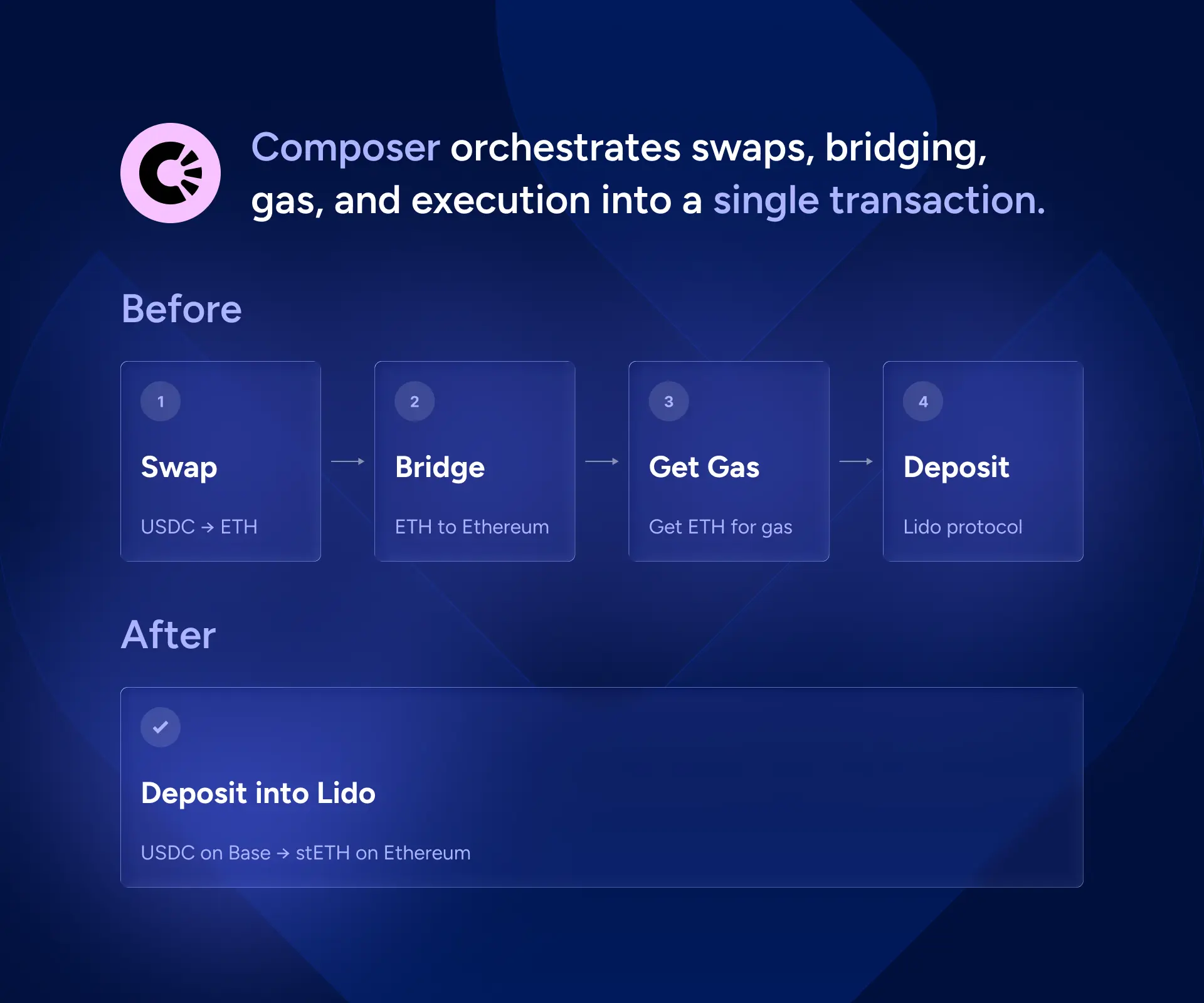
LI.FI Composer is the common base layer, built as an onchain virtual machine for orchestrating transactions, that makes any sequence of money legos executable as a single action. It doesn't matter which chain, which protocol, or how many steps are involved - to the user, it's one click.
In practice, this means swaps, bridges, deposits, staking, and other DeFi actions can be composed into one end-to-end flow that executes atomically. What used to require many steps, many transactions, and many user decisions becomes a single action.
This is the rebundling of DeFi into one-click flows. It preserves the openness and modularity of DeFi, while restoring the convenience that bundling provides. And most importantly, it takes complexity out of the user experience, where it never belonged in the first place.
Unbundling finance was DeFi's breakthrough. It's what let us out-innovate legacy finance in the first place. But clinging to unbundling as an end state is now a mistake. If DeFi wants to scale beyond insiders, it has to stop fetishizing the same old primitives and start optimizing for making life simple for the end users. The winners in the next phase of DeFi will be the ones who understand this early.
If you're building vaults or new DeFi experiences and want to abstract complexity away from your users, we're looking for design partners. Learn more in our docs or reach out on Twitter or Telegram at @arjunnchand.
Disclaimer:
This article is only meant for informational purposes. The projects mentioned in the article are our partners, but we encourage you to do your due diligence before using or buying tokens of any protocol mentioned. This is not financial advice.