The Crypto Neobank Opportunity


Crypto is becoming an increasingly compelling market opportunity for neobanks worldwide because it fundamentally changes the unit economics of global financial products. Blockchains enable finance without borders, allowing fintechs to move money internationally, offer yield-bearing balances, and settle across markets in near real time using stablecoins.
Building crypto-enabled neobanks has been possible for many years, but the opportunity is particularly compelling today because crypto has passed the chasm of institutional adoption and more importantly, regulatory clarity that allows said institutions to offer crypto products. Moreover, the cost and complexity of building on crypto rails has declined; companies can now integrate established blockchain products instead of rebuilding everything in-house. This has collapsed the time and resources required to launch crypto-enabled neobanks, and has made the decision more of a strategic decision instead of a product decision.
The crypto dream now finally has a place in the boardrooms of fintechs and institutions. We’re seeing institutions come into crypto at an unprecedented rate, and they’re coming in hot, with legitimate products and hefty investments into crypto as a new vertical for their businesses. They’re taking this opportunity seriously now because not only does it empirically improve their bottom line by reducing operating costs and capital inefficiencies, it also opens doors for new users and revenue streams.
This article is intended as a practical resource for fintech teams exploring crypto neobanks: what they are, why now is different, how the landscape is evolving, and how teams can go to market efficiently.
Why crypto neobanks, and why now?
Before we go into what crypto neobanks today look like, it’s important to understand in more detail why we’re seeing so many emerge in the first place, and why now. This broadly ties in with why institutions are now venturing into crypto with more intent behind their efforts into seriously expanding their product offerings.
Until recently, crypto and banking largely operated in parallel worlds. Banks focused on regulated fiat rails. Crypto focused on building financial systems where markets are always on, fully transparent, and always earning – a feature set that fundamentally changes what’s possible for global neobanking products.
What were once two separate systems, banking and crypto, are now converging, driven by a number of structural changes:
Regulatory clarity is improving
The last few years have been a watershed moment for stablecoin regulation. Major financial hubs now have clear, enforceable frameworks - from the GENIUS Act (2025) in the U.S. to MiCA (2024-25) in the EU, providing clarity on issuance, backing, and use. The trend is toward “payment stablecoins,” treating tokens fully backed 1:1 by fiat as legitimate, regulated payment instruments.
Stablecoin infrastructure is ready for global adoption
Stablecoin-as-a-service providers now enable teams to issue, manage, and distribute branded stablecoins without building issuance or compliance infrastructure in-house.
Stablecoins are real payment instruments
They’re now widely used for remittances, payroll, subscriptions, and cross-border settlement, not just trading onchain.
Yield products are enterprise-ready
The “DeFi mullet”, where consumer-facing products sit on top of permissioned, risk-managed DeFi protocols, allows fintechs to offer yield without directly managing protocol risk. Large platforms already use protocols like Aave and Morpho under the hood. These protocols offer deep liquidity and structurally higher yields than traditional cash instruments, making single and even double-digit returns viable.
Real-world asset tokenization is increasing
An increasing amount of capital and a growing variety of real-world assets are being tokenized and brought onchain at unprecedented rates – from the U.S. Treasury debt and private credit to commodities like gold and silver, and even equities, virtually everything is finding a digital representation on the blockchain.
Fiat ↔ crypto conversion is operationalized
On- and off-ramps, stablecoin orchestration, custody, and compliance workflows are now handled by specialized providers.
Accounts, wallets, and cards are solved primitives
Crypto accounts, embedded wallets, and card issuance rails are battle-tested at scale and increasingly abstracted from end users, making them easy to be used by the masses.
Chain fragmentation is abstracted away
Interoperability providers have solved access across blockchains, allowing product teams to treat chains as distribution markets rather than technical silos.
Taken together, these shifts dramatically reduce the cost and complexity of launching crypto-powered financial products.
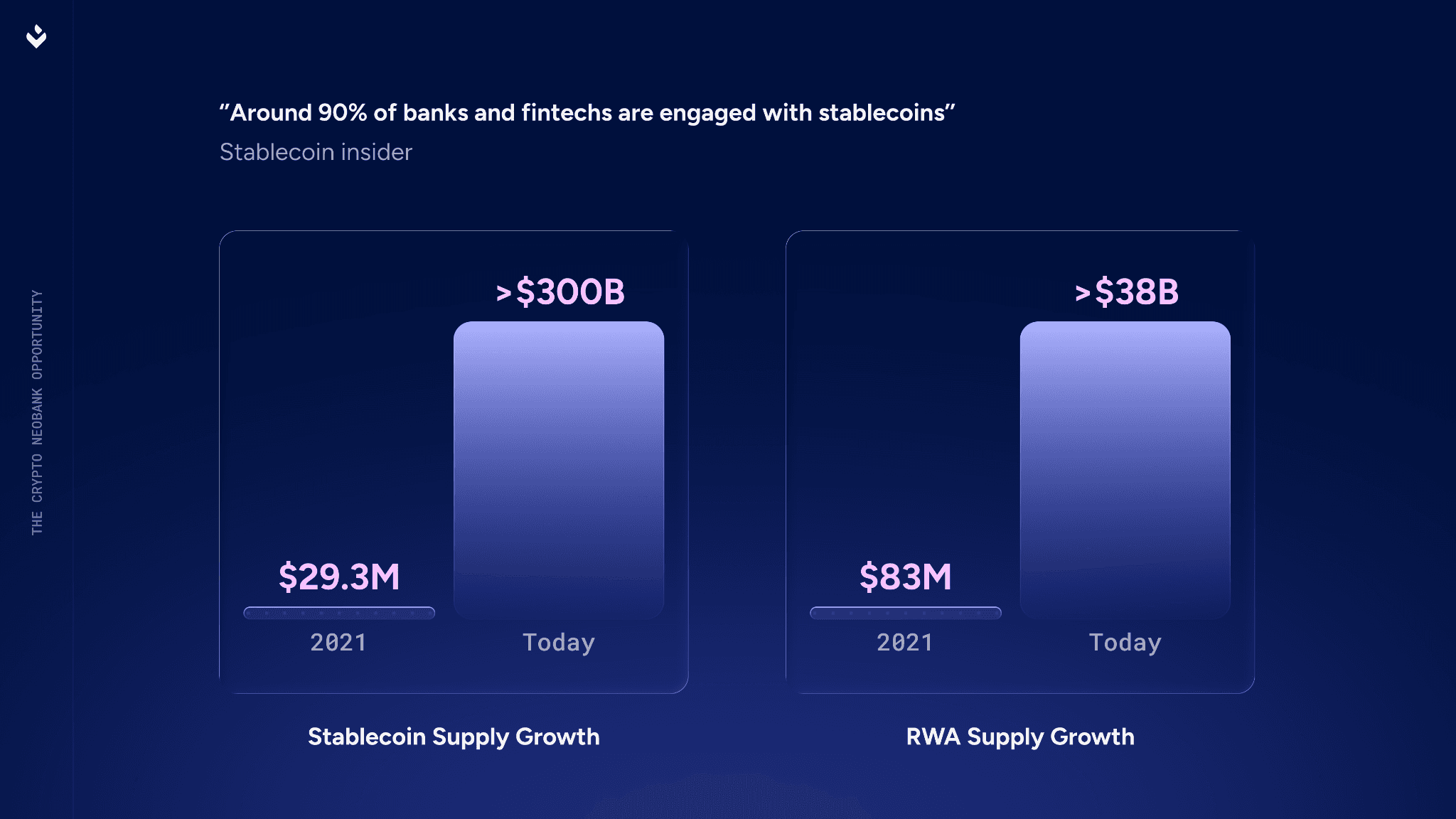
The adoption of stablecoins and real-world assets is not just hype, it also shows in the numbers.
Having understood why the opportunity is so appealing right now, let’s get into how we can understand the anatomy of a crypto neobank.
What is a crypto neobank?
A crypto neobank is best understood not as a new category of online bank, but as a modern financial platform powered by crypto rails. For traditional neobanks and fintech platforms, building a crypto neobank is appealing because it gives users access to the best of crypto - low-cost, global stablecoin transfers, higher-yield opportunities, crypto-backed loans, and digital asset exposure, all without requiring them to manage the complexity of crypto themselves.
At a high level, crypto neobank is a platform that offers one or all of the following features – save, earn, spend, borrow, using crypto rails.
In this context, here’s what we mean by these features:
Save
Users hold money-denominated balances, typically stablecoins, that behave like bank deposits: stable in value, instantly accessible, and globally portable. While settlement happens on crypto rails, the user experience mirrors a traditional savings account.
Earn
Users generate yield on idle balances through crypto-native mechanisms such as lending or staking. Today, this is most commonly delivered via lending markets, aka the DeFi Mullet. Over time, other models, including liquidity provisioning for solvers, may expand available yield sources.
Spend
Users spend crypto-denominated balances via cards, transfers, or onchain payments, with automatic fiat conversion where required. From the user’s perspective, spending feels no different from using a debit account.
Borrow
Users access credit by borrowing against crypto collateral. These products allow customers to unlock liquidity without selling their assets. Bitcoin-backed loans offered by Coinbase demonstrate strong demand for this model.
Trade (adjacent, not core)
Most crypto neobanks embed basic trading functionality, such as 1:1 stablecoin conversions or crypto-to-stable swaps, to support saving, earning, and spending. Not every crypto neobank should lead with trading but most will eventually add trading primitives because integrating trading into the same app reduces friction, unifies the product suite, and creates more opportunities for users to manage their money seamlessly.
Understanding the crypto neobank landscape
Now there’s many ways to approach building a crypto neobank. Some companies are diving straight in, meaning they’re starting from scratch as crypto native companies with the goal to offer crypto-enabled products to first, crypto native users, and eventually to the masses. And then there are others at the opposite end of the spectrum, the fintechs and institutional giants who already have their products in the hands of the masses but see the opportunity in offering crypto-enabled products to their existing customers, and also acquire new customers in the process.
Hence, a useful way to understand the landscape is along two dimensions:
1. Product DNA: Traditional-finance vs crypto-native
Traditional finance - fintechs and banks
These teams start with a fiat-native user base and introduce crypto features to increase engagement or revenue per user. Crypto is additive, not foundational.Crypto-native platforms
These teams build entirely on crypto rails and start with crypto-native users. Their challenge is expanding beyond early adopters to mainstream audiences.
2. Stack depth: how much of the banking stack they serve
Some players offer a narrow slice (e.g. saving or payments). Others aim to cover the full stack: save, earn, spend, borrow.
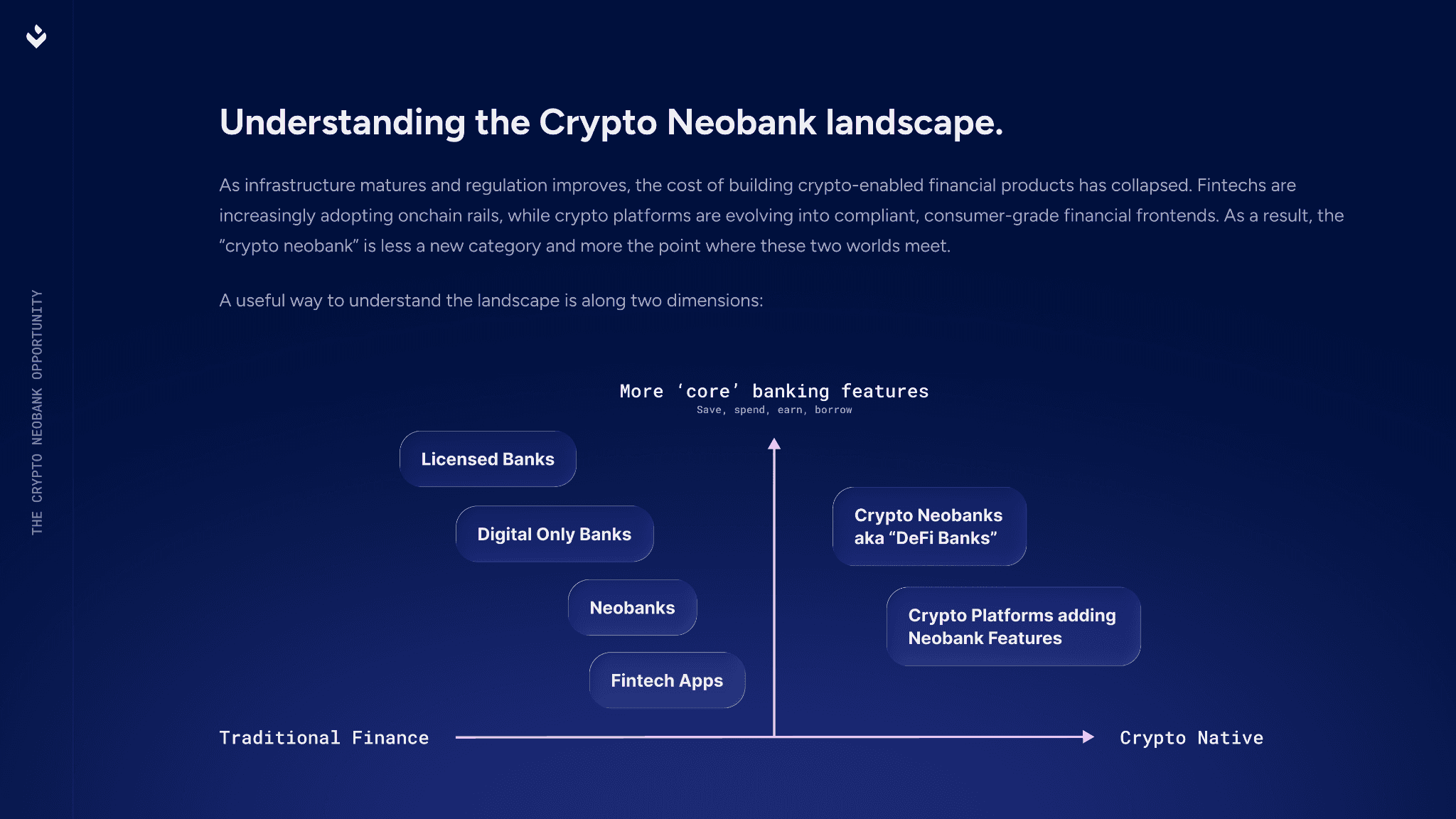
When you map the market this way, a few patterns emerge:
Mainstream fintechs typically start conservatively, treating crypto as a new asset class or payment rail. Many prefer partnerships over building everything in-house, especially given regulatory complexity. Examples include PayPal and Alipay.
Banks are still largely in exploratory phases, constrained by compliance and risk frameworks. Examples include JPMorgan Chase and Deutsche Bank.
Crypto-native teams are building the full-stack banking experience on crypto rails. They’re currently best placed to serve the existing crypto users. The main challenge is breaking out to serve mainstream users. Examples include Ether.fi and Aave.
Crypto exchanges are currently best positioned to onboard new users, as they often serve as the entry point into crypto for non-native users. Examples include Coinbase and Binance.
In practice, many players are moving toward the same destination, even if they start from very different places.
Closing thoughts and where LI.FI can help
Crypto features getting integrated into neobanks was always inevitable–it has always been a question of when and not if–so this adoption and acceleration of the space in this direction feels natural and will only get faster and broader in the future.
This is the crypto thesis playing out. And the most interesting outcome of this proliferation will be a day where every neobank or fintech company offers crypto-enabled products and services to their customers, and the ‘crypto neobank’ category wouldn’t even exist separately - because at that point, most global neobanks will be running some portion of their stack on crypto rails, and the users won’t need to know.
At LI.FI, we’re firm believers in this thesis playing out and are building the infrastructure that teams from all walks of finance can integrate to launch a global neobank with crypto-enabled products.
There are many ways to build a neobank with crypto-enabled products. One would require teams to stitch every integration one by one to enable all the features of a neobank (save, earn, spend, borrow, trade), and the other would save them massive amounts of time and money, by integrating LI.FI they could launch a full suite of crypto-enabled financial products through a single integration.
All while staying focused on product, compliance, and user experience, and leaving the crypto infrastructure bit for LI.FI to figure out for them.
What teams can build with LI.FI
1:1 Stablecoin Payments – With LI.FI Intents, teams can connect to onchain liquidity to support stablecoin conversions and transfers with predictable execution outcomes, integrated into your existing payment and settlement flows.
Simplified access to crypto yield – With LI.FI Earn, teams can provide access to third-party DeFi yield protocols through standardized infrastructure components. Protocol selection, product structure, disclosures, and eligibility remain fully under your control.
Access to real-world assets – LI.FI is the distribution layer for tokenized stocks, and real-world assets more broadly. Teams can enable user-controlled buy-and sell-side execution across cryptocurrencies, tokenized assets, and digital representations of real-world assets through a single access point.
Treasury settlement and liquidity management – With LI.FI’s universal liquidity, teams can support treasury settlement workflows using stablecoins as a digital settlement asset. Onchain rails can help reduce operational complexity and associated settlement overhead across multi-currency treasury operations spanning regions, time zones, and settlement systems.
We’re excited to be working with leading global neobanks to bring crypto-enabled products and services to the masses.
If you’re building the future of modern finance, come talk to us.
Disclaimer:
This article is only meant for informational purposes. “Neobank” is used for descriptive and marketing purposes only. Service providers referred to as “neobanks” may not be licensed, chartered, or otherwise regulated as banks in any jurisdiction and may not be subject to the regulatory framework or supervisory standards applicable to traditional banking institutions. The projects mentioned in the article are our partners, but we encourage you to do your due diligence before using or buying tokens of any protocol mentioned. This is not financial advice.