The Brazilian Financial Paradox


An analysis of Brazilian investor behavior, informal dollarization via stablecoins, and the structural opportunity for financial institutions seeking to lead the next frontier of the fixed-income market.
1. The Brazilian Financial Paradox
Brazil is strange. In a very specific, very Brazilian way.
The country's modern financial narrative revolves around Pix. Launched at the end of 2020, the Central Bank's instant payment system has reshaped the market. Today the ecosystem has 165 million individual users — 156.6 million of whom have already made active transactions — and more than 19 million registered businesses.
The scale is staggering: in 2024 alone, the system settled more than 63.4 billion transactions, moving a volume equivalent to US$ 4.6 trillion. That excellence turned Brazil into a technology exporter. Colombia launched its own instant-payment system, Bre-B, explicitly modelled on the Brazilian framework and built with technical cooperation from Brazilian specialists.
Brazil is one of the few countries in the world with a digital-payments infrastructure that rivals — and often surpasses — what exists in far wealthier markets, including the United States.
And yet Brazil is still the country where the savings account (caderneta de poupança) is the number-one investment. Where talking about stocks at the dinner table sounds like speculation or gambling, and where "saving money" and "investing money" remain, for most people, entirely different things.
This is not laziness. Not ignorance. It is history.
History Explains Everything
To understand Brazilian financial conservatism, we need to revisit the past. Brazil has officially gone through nine monetary standards — seven different currencies in the republican era alone: Réis, Cruzeiro, Cruzeiro Novo, Cruzado, Cruzado Novo, Cruzeiro Real and the current Real. Monetary disorder peaked in 1993, when the IPCA recorded accumulated inflation of 2,477% per year. Purchasing power evaporated daily, conditioning the population to seek immediate liquidity solutions.
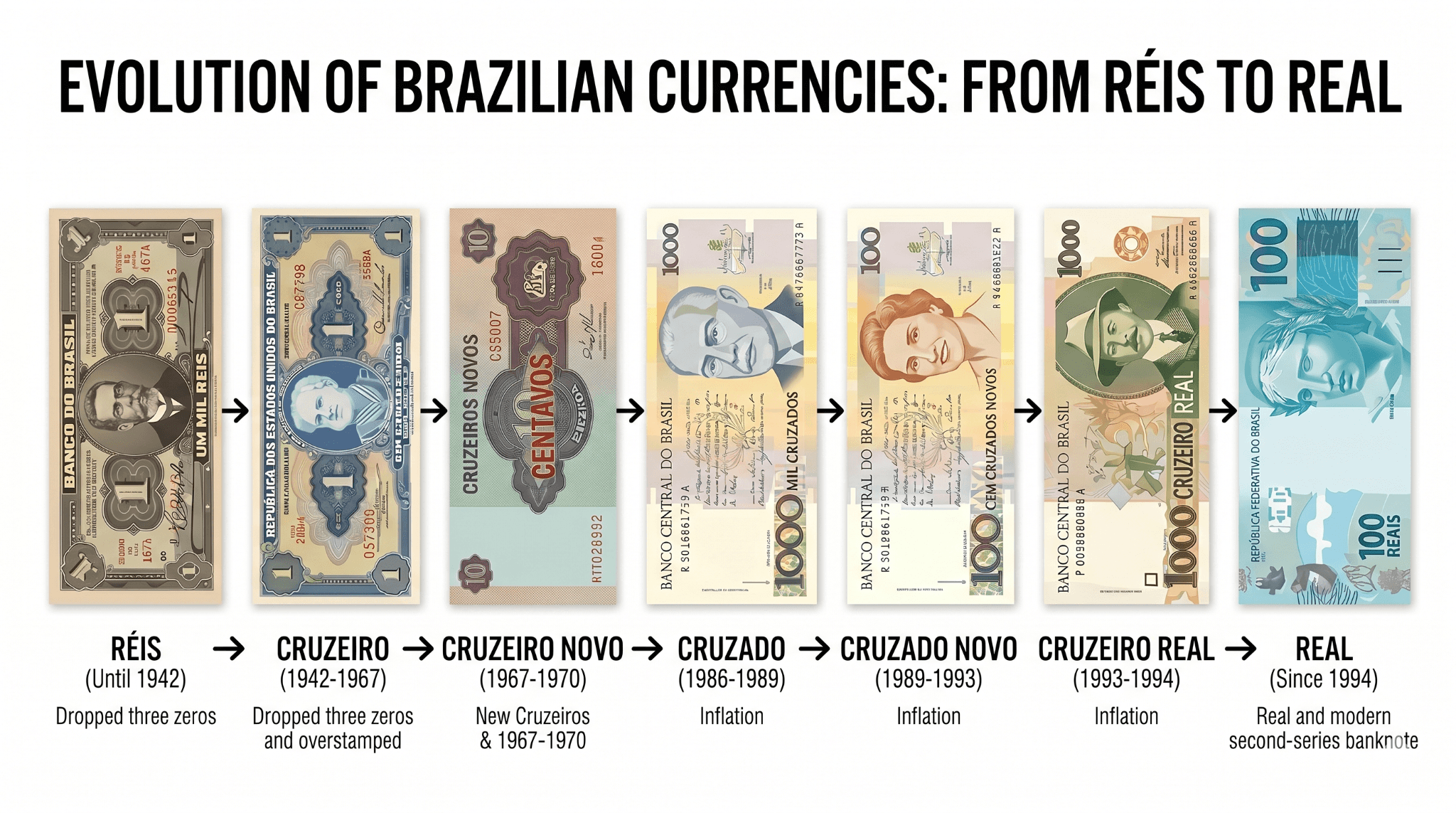
Evolution of Brazilian currencies — from Réis to Real.
The deepest scar came in March 1990 with the Collor Plan. The measure compulsorily froze current accounts and savings deposits, abruptly squeezing roughly 80% of the Brazilian economy's liquidity for 18 months. That brutal rupture of the social contract taught Brazilians — through pain — an enduring lesson: no macroeconomic foundation can survive a stroke of the government's pen. That is where the fear was born.
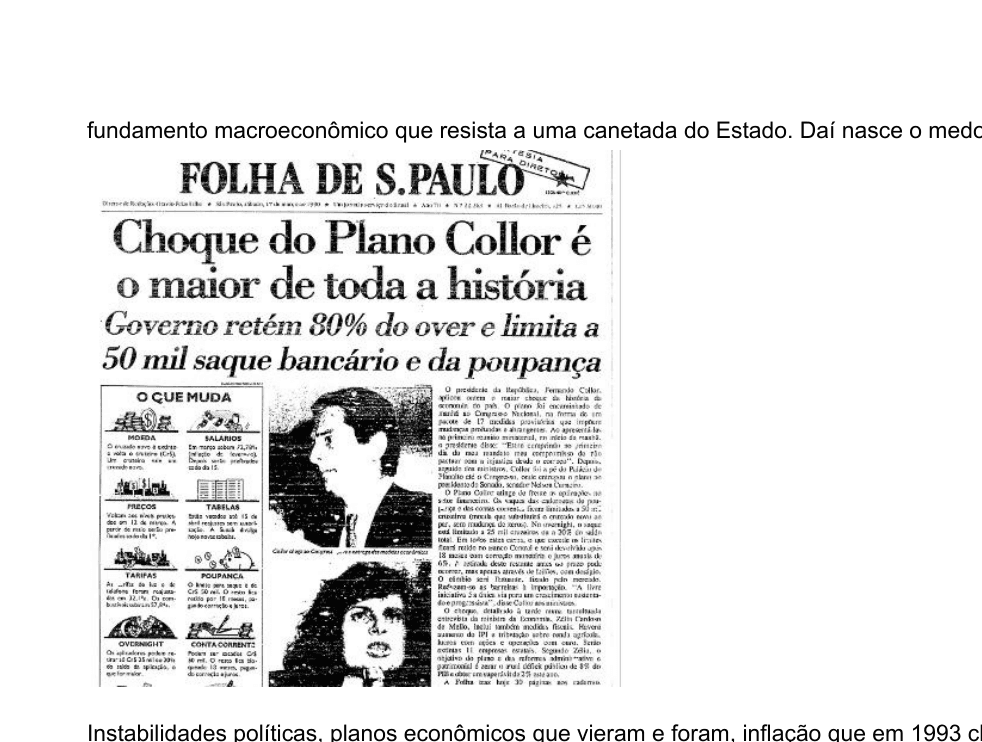
Folha de S.Paulo, March 1990 — The Collor Plan froze 80% of Brazil's economic liquidity for 18 months.
Political instabilities and economic plans that came and went left an indelible mark: Brazilians learned, in practice and with pain, that putting money into anything that promised growth was a real risk of losing everything. We discovered that even the most conservative yield we have is not bulletproof.

Brazilian Inflation (IGP-DI, 12-month) — 1945 to 2026. Focus: the Collor Plan hyperinflation and the long road to monetary stability. Source: FGV, BCB.
Even in the face of historical economic instability and the risk of recessive cycles, the savings account remains Brazilians' largest investment, because no economic thesis can survive a stroke of the pen. Stocks fluctuate, prices fall, reserves are liquidated. Brazilians know what can happen overnight, and that economic security — as in many emerging countries — is never guaranteed.
Brazilian financial conservatism is not a cultural trait. It is a rational response to decades of institutional trauma. And here lies the paradox: this very same Brazilian — who is afraid of stocks, who prefers savings over anything that 'fluctuates' — is among the world's largest adopters of cryptocurrencies.
This legacy shapes current behavior. According to projections for 2025/2026 in the 9th edition of ANBIMA's Brazilian Investor X-Ray, 36% of the population holds some type of financial product.
Despite greater digital access to brokerages, the savings account still dominates with 22% portfolio penetration. When asked, nearly half of savers cite 'safety' as their primary reason. There is a gradual migration — but only toward products with the same predictability: private fixed-income instruments (CDB, LCI, LCA) rose to 7%. Meanwhile, B3 equities remain marginalised at an anaemic 2% of national preference. Brazilians flee volatility to avoid triggering their memories of wealth destruction.
What Brazilians lack is something that delivers the returns of risk assets with the safety of a savings account. But to understand the investor profile, we first need to understand what the Brazilian market currently offers.
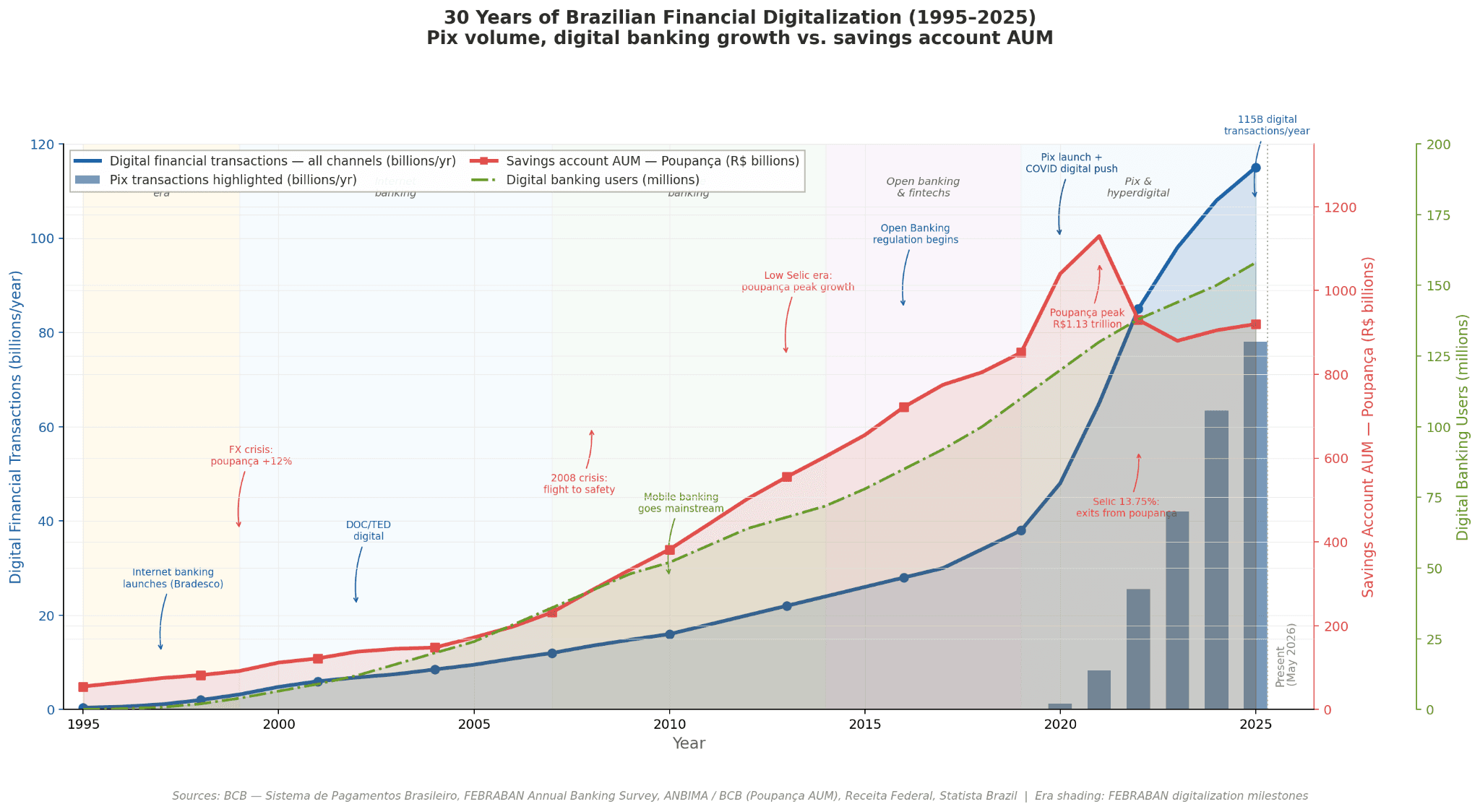
30 Years of Brazilian Financial Digitalization (1995–2025): Pix volume, digital banking growth and savings account AUM evolution. Source: BCB, FEBRABAN, ANBIMA.
2. Brazilian Investments
We need to examine what Brazilians consider a reference "safe investment." According to ANBIMA, the total financial volume invested by individuals in Brazil reached R$ 8.58 trillion at end-2025 — an impressive 15.5% growth over year-end 2024. The money is moving. The question is: where?
To understand the domestic market, here are the Top 5 investments where Brazilians anchor their money:
1. Savings Account (Poupança): The untouchable favourite. Protected by the FGC deposit-guarantee fund and exempt from income tax. Yields 0.5% per month plus TR, resulting in roughly 10.5% per year. The problem: this return historically loses to inflation, silently eroding purchasing power.
2. CDB (Bank Deposit Certificate): The natural next step for those leaving the savings account. The investor lends money to the bank in exchange for CDI-linked interest, typically 100%–110% of the CDI — equivalent to 14.4%–15.8% gross per year, or 12.2%–13.5% net after income tax. Total CDB holdings reached R$ 1.33 trillion at end-2025.
3. Tesouro Direto (Treasury Direct): The country's safest investment, backed by federal government debt. Tesouro Selic yields roughly 11.75% per year net; Tesouro IPCA+ guarantees IPCA plus a real rate, locking in above-inflation returns over the long term.
4. LCI and LCA: Real-estate and agribusiness credit notes. They function almost identically to CDBs but carry a tax benefit: income-tax exemption. With typical issuances at 91% of the CDI, they deliver roughly 13.1% per year net.
5. Investment Funds: A financial 'condominium' where a professional manager decides the allocation. A typical DI fund yields roughly 11.5% per year net, after management fees and 15% income tax.
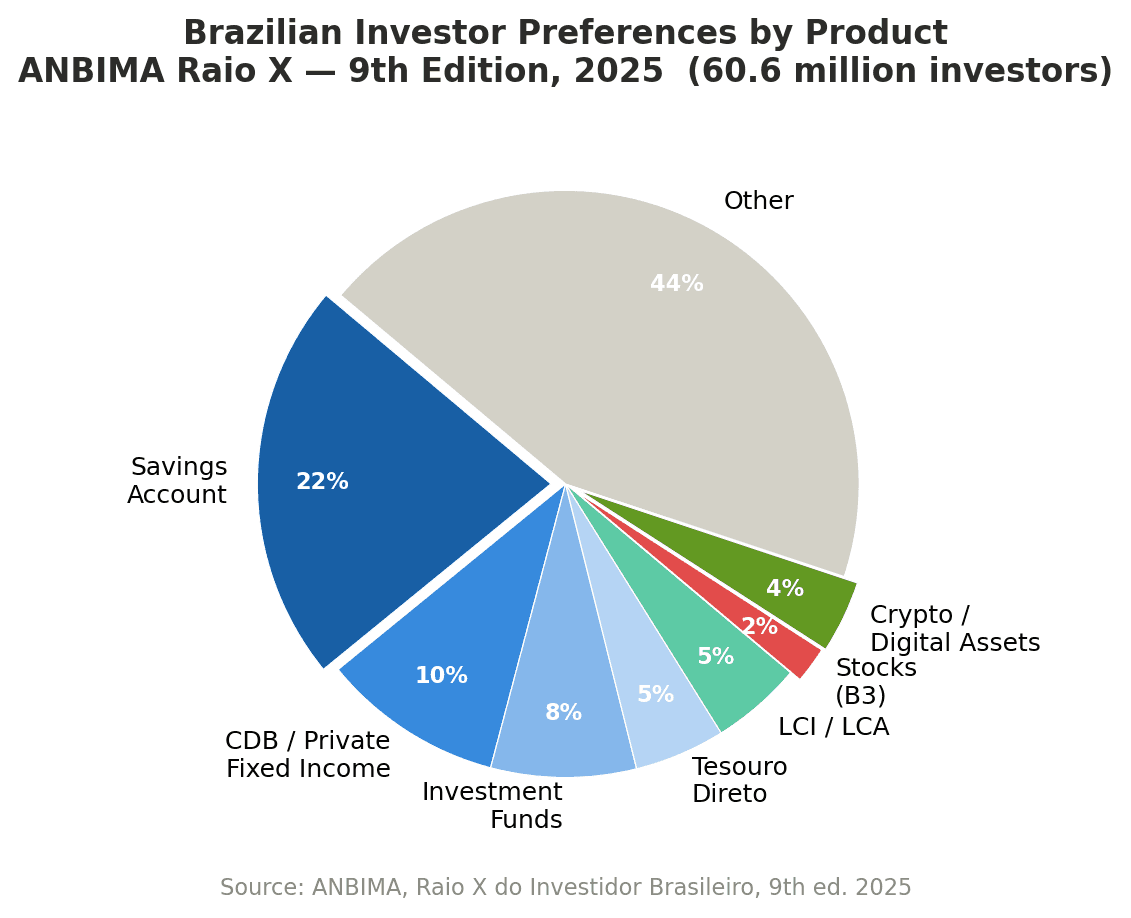
Preference distribution among Brazil's 60.6 million investors. Source: ANBIMA, Brazilian Investor X-Ray, 9th ed. 2025.
3. Brazil, Cryptocurrencies and Informal Dollarization
How do we reconcile this dread of volatility with Brazil being a crypto powerhouse? According to the Chainalysis Global Crypto Adoption Index 2025, Brazil jumped to 5th place globally in digital asset adoption. Between the second half of 2024 and mid-2025, the country moved US$ 318.8 billion in cryptocurrencies — a volume equivalent to nearly one third of all Latin American transactions, surpassing economies with severe inflation such as Argentina (US$ 93.9 billion) and Mexico (US$ 71.2 billion).
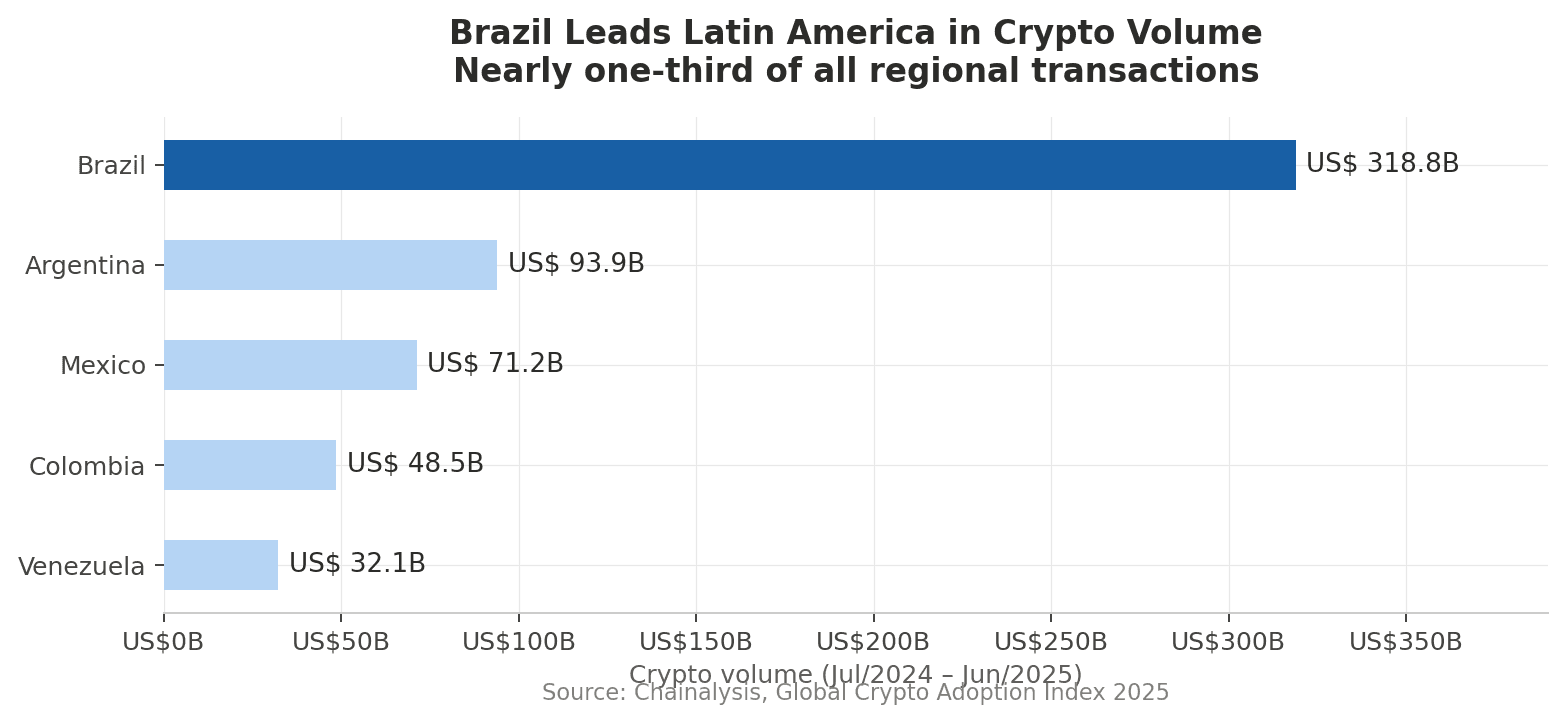
Brazil leads Latin America in crypto volume (Jul/2024–Jun/2025). Source: Chainalysis, Global Crypto Adoption Index 2025.
The secret is not speculation in Bitcoin, but an extreme search for safety. Central Bank and market data indicate that roughly 90% of all crypto flow in Brazil is directed toward stablecoins — digital currencies that maintain a rigid 1-to-1 parity with the US dollar.
This is the paradox resolved: the average Brazilian is not acting as an aggressive trader. He uses the speed of Pix to send reais to crypto exchanges, immediately converting them into 'digital dollars.' A 'super-savings account' has emerged: 21st-century technological ease shielding wealth against the political traumas and currency weaknesses of the 20th century.
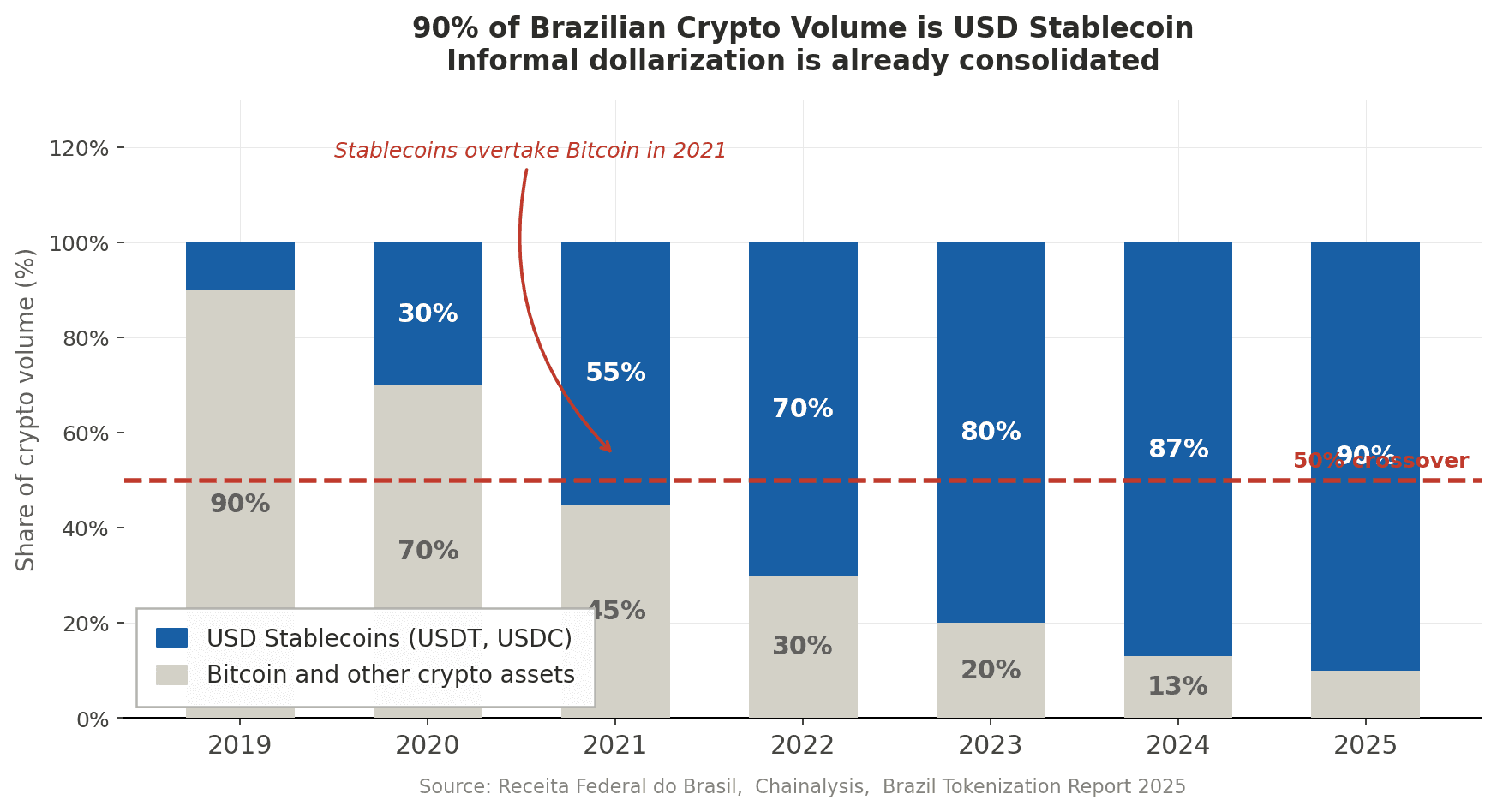
90% of Brazilian crypto volume is USD stablecoin — informal dollarization is already consolidated. Source: Receita Federal do Brasil, Chainalysis, Brazil Tokenization Report 2025.
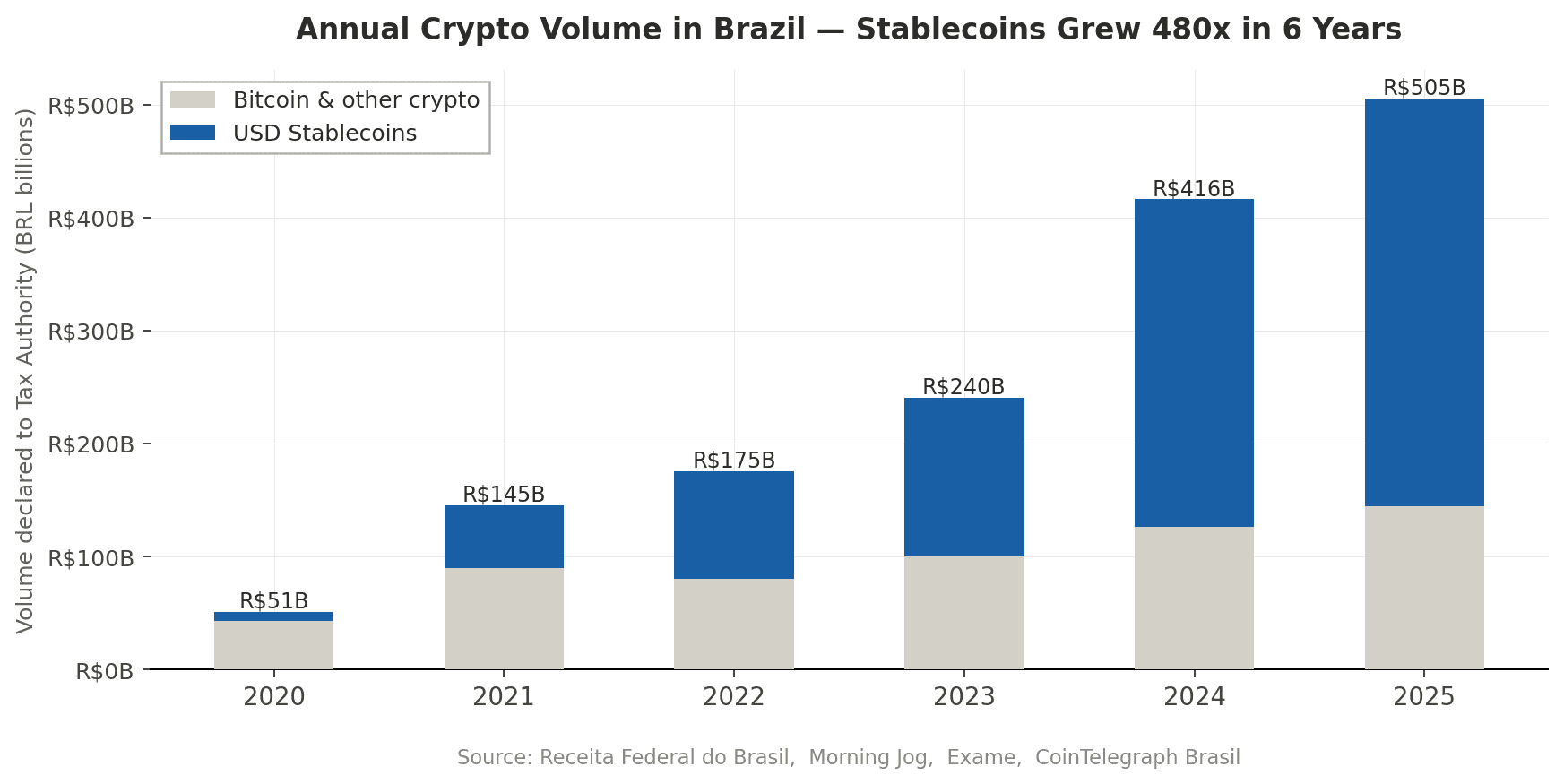
Annual crypto volume declared to Brazil's tax authority (R$ billions). Stablecoins grew 480x in six years. Source: Receita Federal do Brasil.
3.1 Why Isn't There Simply a Dollar Account in Brazil?
If Brazilians seek so much protection against inflation and government instability, wouldn't the logical solution be simply opening a dollar bank account? The answer is no, because it is prohibited by law. Since the 1930s — firmly consolidated by Decree-Law 857/1969 — Brazil requires legal tender status for the national currency. The Civil Code (arts. 315 and 318) expressly prohibits contracts denominated in foreign currency on Brazilian territory. The 2021 FX Framework modernised the exchange market but kept this restriction intact for individuals and ordinary companies.
It is precisely this legal gap that explains the growth of stablecoins in the country. Without legal access to domestic physical dollars, Brazilians found in stablecoins a practical path to diversify their FX exposure within their own territory. The prohibition did not curb demand — it redirected it to the decentralised market. Yet, everything has a 'but' in Brazil.
4. LI.FI and Brazil — The Regulatory Solution
The use of dollar-pegged stablecoins (such as USDT and USDC) had been functioning as this 'super digital savings account.' However, the Central Bank monitored the evolution of this market and, between late 2025 and early 2026, structured a new regulatory framework.
The key change came with BCB Resolution 521/2025 (in effect since February 2026), which classified the purchase of dollar-referenced stablecoins as a foreign-exchange transaction subject to a 3.5% IOF-Câmbio tax. BCB Resolution 561/2026 complemented the framework by restricting the use of those coins for certain international remittances (eFX). In parallel, BCB Resolution 520/2025 created VASP licensing in Brazil, equating regulated exchanges with the financial system and opening space for authorised institutions to structure and distribute products with digital assets. Normative Instruction BCB 701/2026 detailed proof-of-reserves and technical-certification requirements, raising governance standards across the sector.
It was in this regulatory context that LI.FI Earn found its relevance as an infrastructure protocol for financial institutions wishing to offer exposure to dollar-denominated yields.
4.1 How Does LI.FI Earn Work in Practice?
The starting point is the Brazilian investor's need to protect wealth from currency depreciation, within an environment where direct access to physical dollars is legally restricted.
The solution structured by LI.FI Earn begins at the partner broker or bank. Instead of acquiring dollar-referenced stablecoins — an operation treated as foreign exchange since BCB Res. 521/2025 — the institution operates with BRL-pegged stablecoins such as BRL1, BRLA or BR, instruments distinct in terms of the underlying asset. The Central Bank's current regulation has not classified BRL-referenced stablecoins as foreign-exchange operations.
From that point, the partner institution that is issuing these dollar-yield products connects the yield strategies to the LI.FI Earn ecosystem, which offers a streamlined developer UX to integrate them into any app, wallet, or neobank and make them available for their users – with built-in cross-chain execution that ensure users are able to deposit/withdraw into these strategies without being bogged down by the multi-chain complexity of the crypto ecosystem.
Regulatory note: The structure described operates on the basis of the current regulatory distinction between BRL-referenced stablecoins and USD-referenced stablecoins, as established by BCB Res. 521/2025. The tax and regulatory treatment of digital-asset operations is still evolving in Brazil. Any institution considering distributing this product should obtain independent legal advice from a Brazilian financial and tax law specialist, covering IOF treatment, Receita Federal reporting obligations and capital registration under applicable FX regulation.
What the Investor Gets from This Structure
The operational complexity behind the scenes translates into a simple product for the end client, addressing four structural demands of the Brazilian investor:
Currency protection: The portfolio gains exposure to the strength of the global economy and reduces dependence on the real's performance.
Dollar-denominated yield: Capital does not merely preserve dollar value — it generates dollarised returns sourced from international financial markets.
Structure within the current regulatory framework: The operation starts from BRL stablecoins, distinct from the dollar stablecoins regulated by BCB Res. 521/2025. The structure was designed to respect the current normative framework; independent legal validation is recommended before any distribution.
Accessibility: No foreign accounts or special legal entities required. Distribution occurs via the partner institution's existing interface.
The practical result of this structure is what can be called economic dollar exposure within a Brazilian operational framework — with the benefits of dollarised yield and compliance with the regulatory framework in force at the date of this publication.
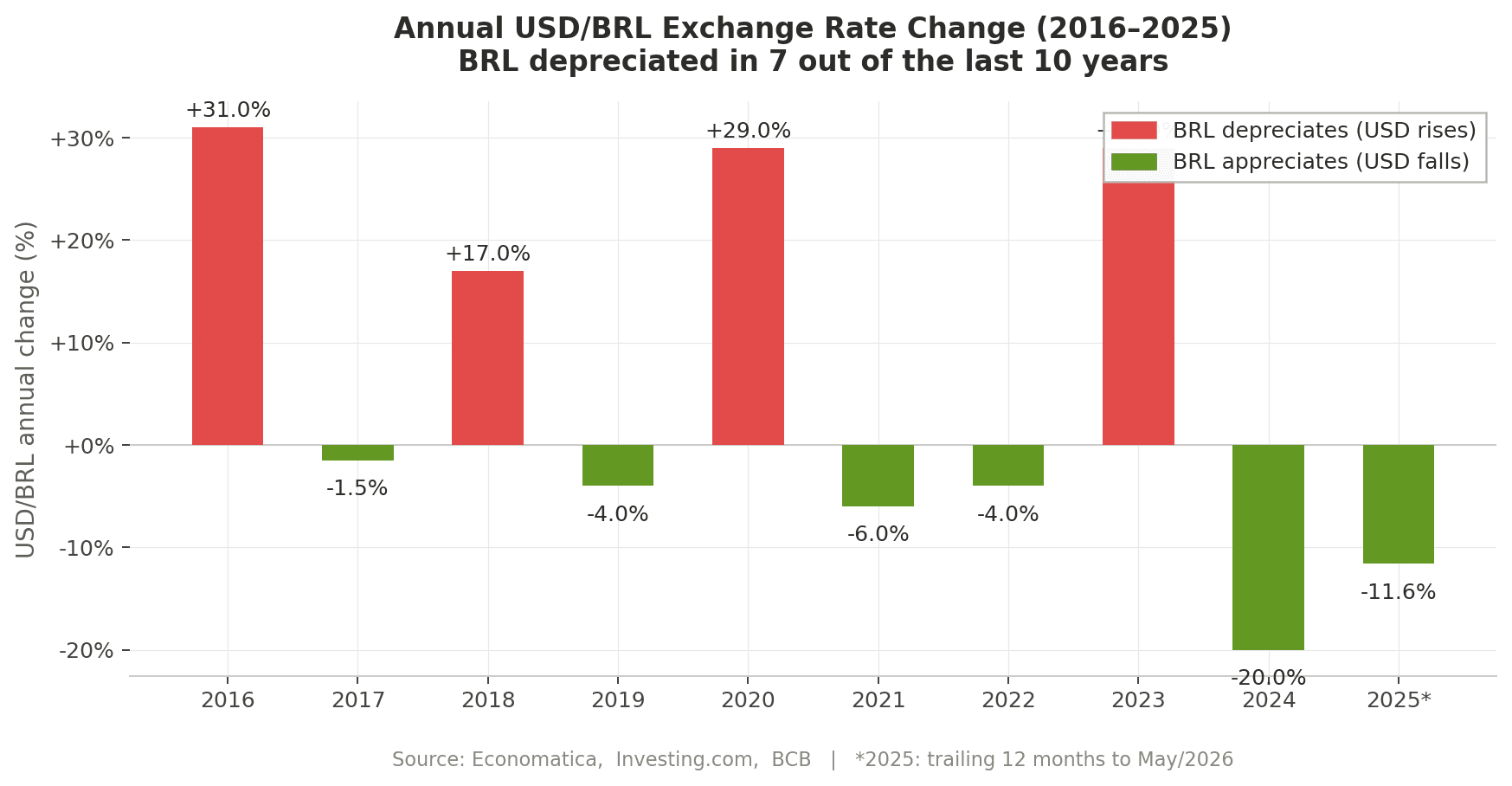
Annual USD/BRL exchange-rate change (2016–2025). In 7 of the last 10 years the real depreciated against the dollar. Source: Economatica, Investing.com, BCB.
5. Why Offering Dollar Yield is TradFi's Next Frontier
The Brazilian investor lives with a chronic contradiction: among the world's highest domestic interest rates coexist with a currency that consistently loses value against the dollar. A Selic rate of 14.5% per year sounds attractive — until the real depreciates and the real USD gain shrinks significantly. By law, the obvious solution of simply opening a dollar account remains prohibited. This creates a structural opportunity for the institution that positions itself first.
R$ 5.06 | -11.6% | 14.5% | < 3% |
USD/BRL · May/2026 | BRL/USD change last 12 months | Current Selic | Real USD gain after typical depreciation |
The Product: Dollar Yield via LI.FI Earn
LI.FI Earn is a B2B API that aggregates yield strategies from more than 20 DeFi protocols — including Aave, Morpho, Midas, Euler and others — in a single integration point, with cross-chain execution across more than 60 blockchains. For a TradFi institution, this represents the ability to launch a dollar-yield product without building DeFi infrastructure internally. API integration takes 4–8 weeks for a mid-sized engineering team, with no requirement for validator nodes, private-key custody or proprietary blockchain infrastructure.
Protocol | Est. APY | Strategy | Risk Profile |
Aave v4 USDC | 5.0–6.0% | Overcollateralized lending | Conservative |
Morpho (Gauntlet/Steakhouse) | 6.0–7.0% | Curated vaults, peer-to-peer matching | Moderate |
Ethena sUSDe | 5.0–9.0%* | Delta-hedge, basis trade on derivatives | Moderate-High |
* Note on Ethena sUSDe: sUSDe yield is variable and derived from funding rates of perpetual futures contracts on derivatives platforms. In bearish markets or when the funding rate turns negative, the yield may be below the indicated range or temporarily negative. Institutions distributing this product must assess its suitability for each client profile in accordance with applicable CVM regulation.
The institution does not need to understand the internal mechanics of DeFi protocols. It only needs to integrate the API, define which strategy to offer each client profile, and distribute the product via its existing interface — app, internet banking or investment platform.
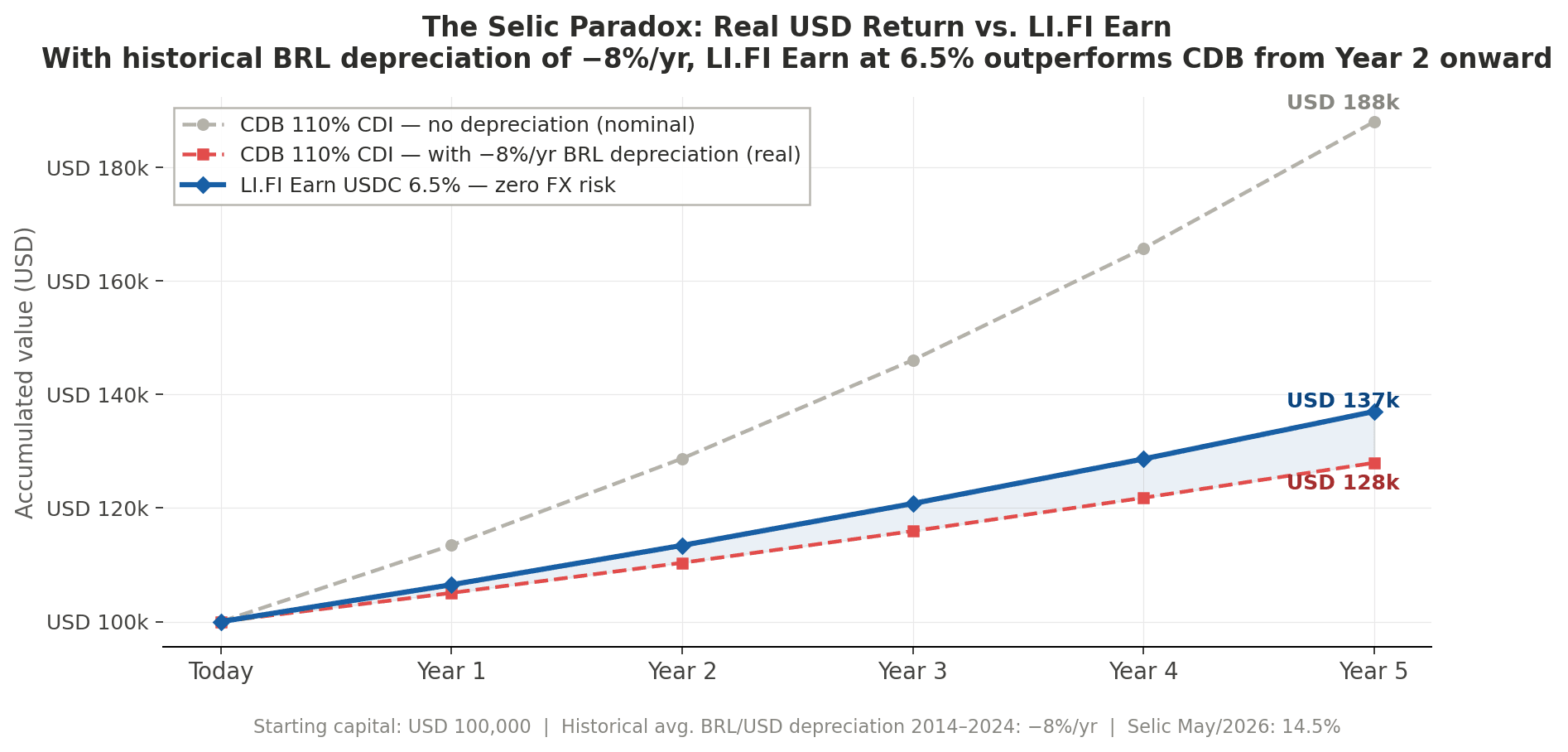
The Selic Paradox: with historical BRL depreciation of -8%/yr, LI.FI Earn at 6.5% outperforms CDB 110% CDI in real USD terms from Year 2 onward. Starting capital: USD 100,000. Source: BCB, proprietary projection.
The Business Case
Clients with R$ 500k–R$ 5 million in financial assets already diversify through currency funds, BDRs and overseas transfers. Offering dollarised yield exposure directly within the institution's app eliminates that friction and retains assets that today migrate to international brokerages such as Interactive Brokers and Avenue.
The model is non-custodial: the client deposits directly in on-chain protocols, the institution distributes and charges a spread or platform fee — typically 0.5%–1.5% per year on AUM. There is no credit risk on the institution's balance sheet, unlike a CDB issued by the bank itself.
Regulatory timing matters. Institutions that structure and validate this product in 2026 will arrive before the market consolidates. New BCB rules expected in the second half of 2026 should bring greater regulatory clarity — those who already have the product running will be far better positioned to adapt quickly.
Demand is proven by the data: the Receita Federal reported R$ 14.7 billion in USDT transactions in October 2024 alone — nearly four times the Bitcoin volume in the same period. That flow already exists. The question is whether the institution will structure a regulated product to capture it — or leave it in the hands of unregulated exchanges.
For a client with R$ 1,000,000 over a one-year horizon, a CDB at 110% CDI delivers R$ 134,600 gross — approximately USD 26,601 at the current rate of R$ 5.06. If the real depreciates 10% over the year, that dollar gain falls to USD 18,819. A dollarised yield strategy via LI.FI Earn can deliver between USD 12,846 and USD 17,787 with no FX exposure, D+0 liquidity and independence from the real's behaviour. In scenarios of currency stress — exactly when clients most need protection — the absence of FX risk in the DeFi product becomes its greatest comparative advantage.
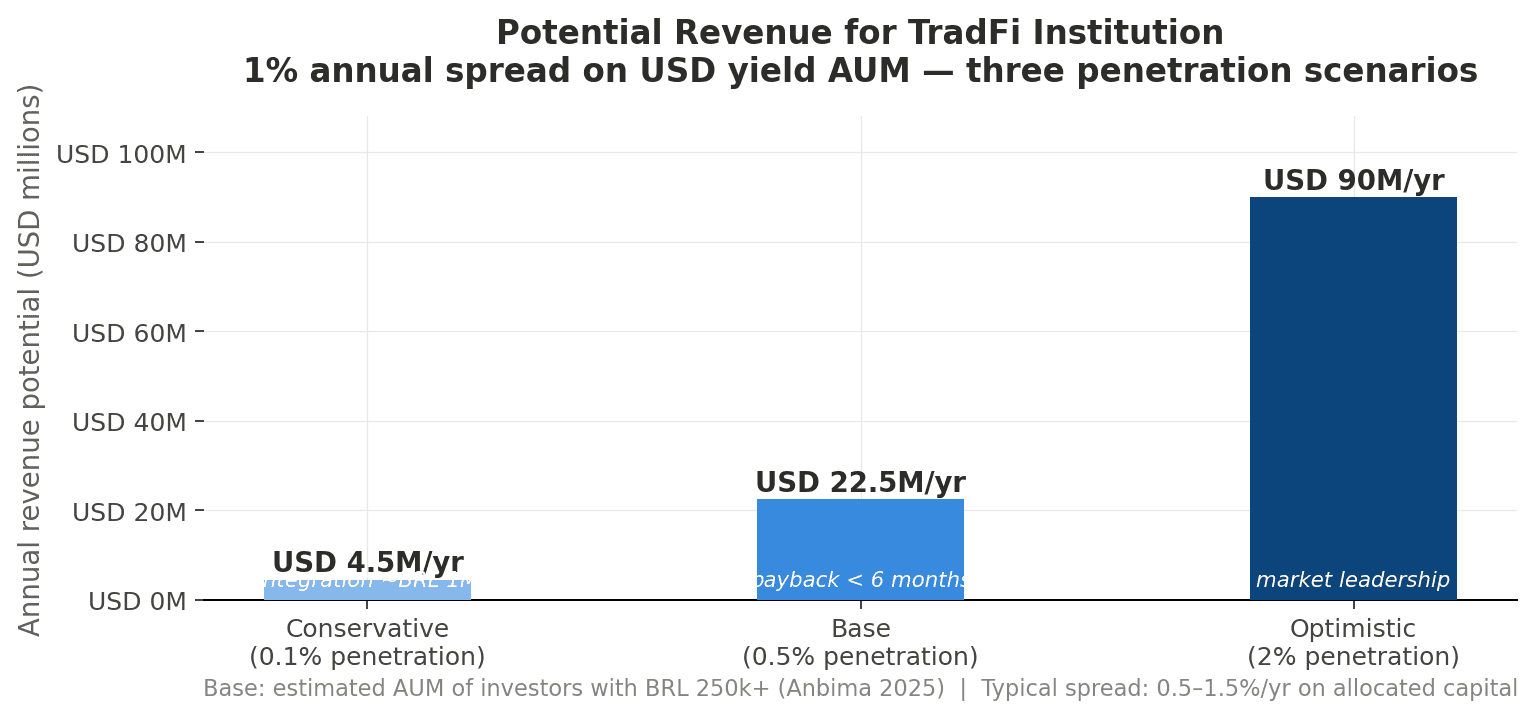
Potential annual revenue for a TradFi institution at 1% annual spread on USD yield AUM, across three market-penetration scenarios. Base: estimated AUM of investors with R$ 250k+ (Anbima 2025).
Regulatory Considerations and Recommended Due Diligence
Before launching any product based on this structure, the interested institution should carry out, at minimum, the following validation steps:
Obtain independent legal advice from a firm specialising in Brazilian financial and tax law, covering: (i) tax treatment of on-chain conversion under BCB Res. 521/2025 and the general anti-avoidance rule (CTN, art. 116, sole paragraph); (ii) capital registration obligations under BCB Res. 278/2022 and applicable FX legislation; (iii) Receita Federal reporting obligations.
Assess the suitability of the offered protocols for each client segment, with particular attention to the risk profile of Ethena sUSDe (variable, based on derivatives funding rates).
Verify VASP classification under BCB Res. 520/2025 if the institution does not yet hold that authorisation or a partnership with an authorised entity.
Analyse how assets allocated in on-chain protocols will be treated accounting-wise and reported to the BCB under applicable COSIF standards.
This document is exclusively informational and analytical in nature. It does not constitute an investment recommendation or legal, tax or regulatory advice. The analyses presented reflect the regulatory framework in force at the date of publication (May 2026) and are subject to change arising from new regulations, administrative interpretations or judicial decisions. LI.FI does not provide regulated services in Brazil and bears no responsibility for distribution or structuring decisions made by Brazilian financial institutions based on this material.
Conclusion — LI.FI Earn and Brazil's Unique Market Moment
Brazil has reached a rare crossroads in financial market history. On one side: 165 million Pix users, 90% of crypto volume concentrated in dollar-pegged stablecoins, and R$ 8.58 trillion in individual assets in continuous search of wealth protection. On the other: decades-old legal barriers preventing direct access to domestic physical dollars, and a new regulatory framework that has made the informal dollarisation route via USDT and USDC more costly. At the centre of these two forces, LI.FI Earn positions itself as infrastructure for accessing dollarised yield — starting from real-denominated assets and operating within the framework under construction.
The Problem the Market Has Not Yet Solved
No traditional Brazilian financial product delivers what investors truly need: positive real dollar yield, within the country, without the complexity of foreign accounts, without remittance costs, and without the vulnerability of a currency that historically loses value. Currency funds exist but charge fees and have limited liquidity. BDRs offer exposure to foreign companies but are not fixed income. FX-linked COEs have complex structures and restricted liquidity. The savings account systematically underperforms dollar inflation. The CDB at 110% CDI looks attractive in reais — but converts to a negative real dollar return in moments of greatest currency pressure, precisely when the client most needs protection.
This vacuum is not accidental. It is the product of decades of legal restrictions that prevented the natural formation of a dollarised fixed-income market for Brazilian retail and high-net-worth investors. Demand exists and is proven by the R$ 361 billion in stablecoins declared to the Receita Federal in 2025. What was missing was a regulated product, distributable by a licensed institution, with transparency and governance compatible with TradFi standards.
What LI.FI Earn Delivers to the Partner Institution
For a Brazilian financial institution, integrating with LI.FI Earn represents the ability to launch an international fixed-income product without building the corresponding infrastructure. The API aggregates more than 20 consolidated DeFi protocols — Aave, Morpho, Midas, Euler, among others — in a single integration point with execution across more than 60 blockchains. Estimated integration time: 4–8 weeks for a mid-sized team, with no private-key custody, no validator nodes and no blockchain infrastructure to maintain.
The revenue model is non-custodial and puts no credit risk on the institution's balance sheet: the client deposits directly in on-chain protocols, and the institution charges a spread or platform fee on AUM — typically 0.5%–1.5% per year. Across the three penetration scenarios analysed, the product generates potential annual revenue of USD 4.5 million (conservative), USD 22.5 million (base) to USD 90 million (optimistic).
D+0 liquidity in lending protocols (Aave, Morpho): clients can redeem at any time without penalty — a significant differentiator versus LCI/LCA with 90-day lock-ups.
Estimated yield of 5%–9% per year in dollars, depending on the protocol, with no FX exposure of the yield to the real's behaviour.
Asset segregation by design: the non-custodial model ensures client funds do not mix with the distributing institution's balance sheet.
On-chain-auditable proof of reserves, compatible with BCB IN 701/2026 requirements.
The Regulatory Timing Advantage
BCB Resolution 520/2025 created, for the first time, a clear licensing regime for VASPs in Brazil. This is not just an entry barrier — it is a competitive advantage for those already operating in TradFi. Unregulated exchanges cannot offer this product within a banking framework. Only a licensed financial institution can do so with the credibility, KYC/AML onboarding and distribution reach that the high-net-worth segment demands.
Institutions that structure and validate the product in 2026 will arrive before the market consolidates. New BCB rules expected in H2 2026 will bring greater regulatory clarity. Those who already have the product running — with usage data and client profiles — will be in a far stronger position to adapt and scale.
The Definitive Argument: Where the Product Wins When It Matters Most
Comparing yields under normal market conditions is relevant. But the definitive argument is different: in scenarios of currency stress — precisely the moments when Brazilian investors most need protection — dollarised yield inverts the relationship with converted domestic products.
When the real depreciates 15% in a year, the CDB at 110% CDI — which nominally delivered R$ 134,600 gross on R$ 1 million — converts to less than USD 18,800, below what a 7%-per-year dollarised yield strategy would deliver with no FX exposure. The product does not compete with the CDB on nominal real-denominated return. It competes on real dollar wealth preservation over time — and on that criterion the DeFi product systematically outperforms domestic instruments during cycles of currency pressure.
Three decades of FX data show that the real depreciates in 7 out of every 10 years. The dollarised yield product is not a bet against the real. It is a structural protective allocation for those who understand that currency diversification is not speculation — it is responsible risk management.
The institution that launches this product is not offering crypto. It is offering currency protection with yield — the product Brazilian investors need most and that the market has never known how to deliver with the right structure.
Sources: BCB Res. 520/2025, 521/2025, 561/2026 · BCB IN 701/2026 · Decree-Law 857/1969 · Civil Code arts. 315 & 318 · Law 14,286/2021 · ANBIMA Brazilian Investor X-Ray 9th ed. 2025 · Receita Federal do Brasil · Chainalysis Global Crypto Adoption Index 2025 · FEBRABAN Annual Banking Technology Survey · Economatica · Investing.com · LI.FI Earn API docs (Apr/2026) · Brazil Tokenization Report 2025 · FGV.
Disclaimer:
This article is only meant for informational purposes. The projects mentioned in the article are our partners, but we encourage you to do your due diligence before using or buying tokens of any protocol mentioned. This is not financial advice.