LI.FI Is Live on Robinhood Chain from Day One

Robinhood Chain brings Robinhood's access-first approach to onchain markets, with Stock Tokens at the center of the experience. Tokenized Stocks turn domestic equity markets into global, 24/7 onchain markets. They take assets people already understand, like equities and ETFs, and make them accessible through wallets, apps, and crypto-native rails. As demand for RWAs grows, Stock Tokens are becoming one of the more familiar entry points into the category: familiar market exposure, delivered through onchain infrastructure.
Robinhood Chain launched to bring traditional markets, crypto, and tokenized real-world assets into one onchain environment. LI.FI went live on Robinhood Chain from day one with support across swaps, Intents, Jumper, and Composer.
That means users and builders can move into Robinhood Chain from the broader onchain ecosystem immediately. Assets can be bridged in, swapped onchain, routed into Stock Tokens, or deposited into yield opportunities through LI.FI.
Full-Stack LI.FI Support on Robinhood Chain
LI.FI is the universal liquidity layer that connects apps to bridges, DEX aggregators, solver networks, and yield protocols through a single integration. With Robinhood Chain support live, apps can offer users a path into the network without building custom bridge integrations, swap routing, token handling, or multi-step transaction orchestration from scratch.
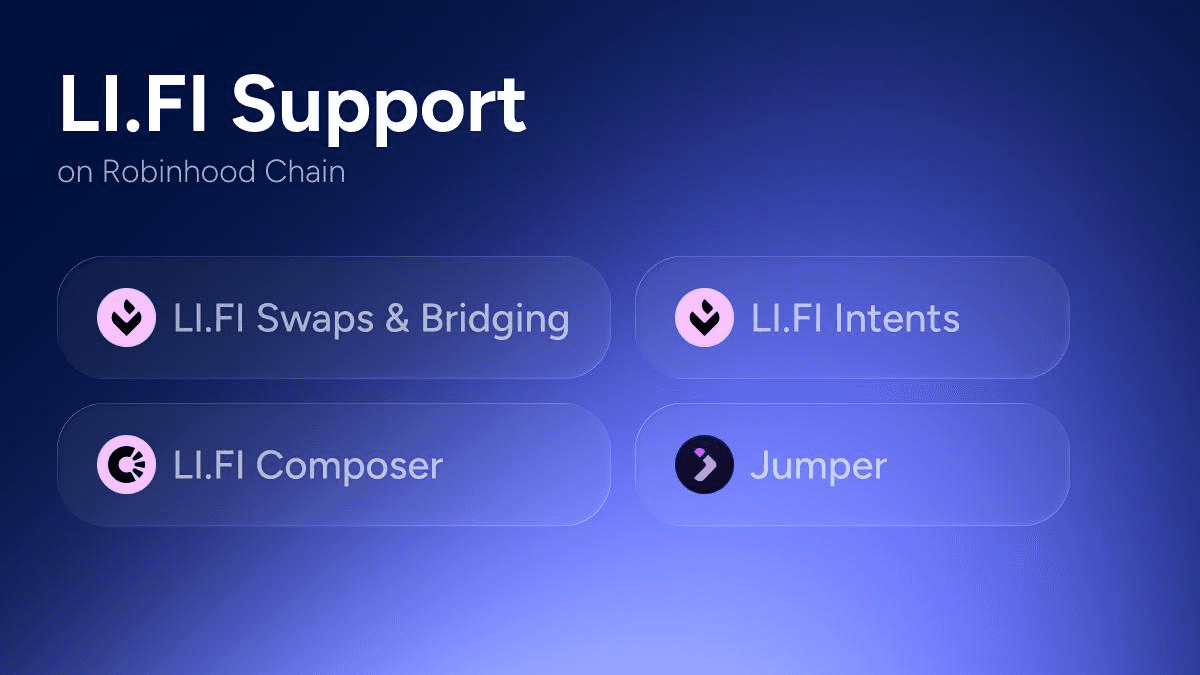
The launch brought four key LI.FI capabilities to Robinhood Chain:
LI.FI swaps for cross-chain and same-chain execution
Stock token access through LI.FI Intents
Jumper support for bridging and swaps to and from Robinhood Chain
LI.FI Composer support for one-click deposits into Morpho and Spark yields
Together, these products make Robinhood Chain immediately reachable from the rest of crypto while giving apps a simpler way to build user experiences around Stock Tokens, DeFi, and yield.
For builders, the takeaway is simple: one LI.FI integration now unlocks cross-chain routing, same-chain swaps, Intents-based Stock Token access, and one-click deposit flows on Robinhood Chain.
LI.FI Swaps Are Live in Robinhood Wallet
Robinhood Wallet users can now access LI.FI-powered swaps on Robinhood Chain.
This includes both cross-chain swaps and same-chain swaps. Users can move assets from other supported chains into Robinhood Chain, route assets from Robinhood Chain back out to other networks, and swap within Robinhood Chain itself.
Under the hood, LI.FI handles route discovery across supported bridges, DEX aggregators, and liquidity sources. The goal is to give users the best available path while abstracting away the complexity of moving between chains or finding liquidity on a new network.
For Robinhood Wallet users, this made Robinhood Chain feel connected from day one. For apps building on the chain, it means cross-chain access and same-chain swaps can be added through LI.FI's API, SDK, or widget without stitching together separate infrastructure providers.
Stock Tokens on Robinhood Chain, Powered by LI.FI Intents
Robinhood Chain is designed around the convergence of crypto and real-world assets. Stock tokens are a central part of that story, and LI.FI Intents make them reachable through a developer-friendly routing layer.
In Robinhood Wallet, stock token access can now be powered by LI.FI Intents. Users can start from the assets they already hold and move into Stock Tokens on Robinhood Chain through a cleaner, intent-based execution flow.
With LI.FI Intents, users can express what they want to receive, and solvers compete to fill that request. Instead of forcing users to manually bridge, swap, and source the right asset, an app can offer a more direct path: fund a Stock Token on Robinhood Chain using an asset the user already holds on another chain.
For example, a user could start with USDG on one chain and end with SPACEX stock on Robinhood Chain. LI.FI Intents handle the execution path behind the scenes.

This is especially important for tokenized real-world assets. These assets often require liquidity sources and execution paths that traditional bridge-and-DEX routing cannot fully cover. Intents extend LI.FI's routing layer beyond standard token movement and into solver-sourced execution, making stock tokens accessible through the same kind of integrated experience users already expect from swaps.
For developers, this turns RWA access into an API-level capability. Apps can offer stock token routes on Robinhood Chain without having to build solver infrastructure or custom execution systems themselves.
Learn more about LI.FI Intents: https://docs.li.fi/lifi-intents/introduction
Jumper Now Supports Robinhood Chain
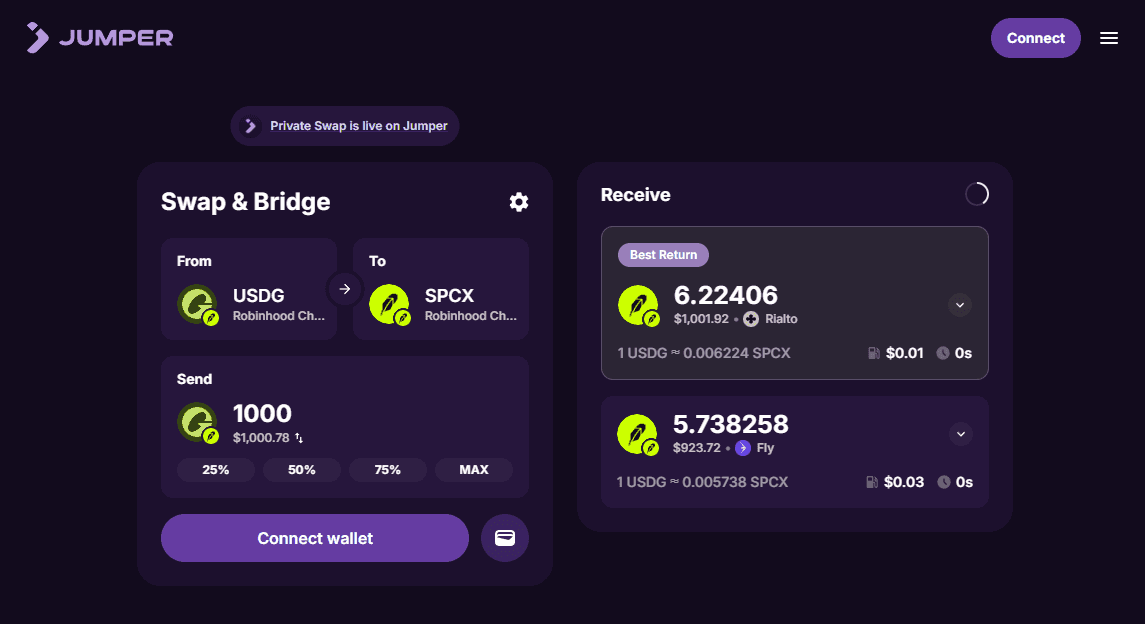
Jumper is also live with Robinhood Chain support.
https://x.com/jumperapp/status/2072418995219931293
Users can now use Jumper to bridge assets to Robinhood Chain, bridge assets from Robinhood Chain to other supported networks, and execute same-chain swaps on Robinhood Chain. This gives users a simple, familiar interface for moving into and around the new network.
For anyone looking to access Robinhood Chain directly, Jumper provides an immediate path in.
Swap now: https://jumper.xyz/
LI.FI Composer Brings One-Click Yield to Robinhood Chain
The experience is straightforward: a user chooses a yield opportunity on Robinhood Chain, funds it with any supported asset from any supported chain, and signs once. Composer handles the route underneath, including the swap, bridge, and deposit steps required to complete the flow.
For users, that removes the usual friction of depositing into DeFi. There is no need to manually bridge funds, swap into the correct asset, return to the app, approve another transaction, and then finally deposit. Composer packages the workflow into a single guided action.
For apps, this removes a large amount of orchestration work. Instead of building and maintaining custom logic for multi-chain deposits, apps can use LI.FI Composer to handle the routing and deposit flow underneath. The app ships the experience; Composer handles the execution path.
Learn more about LI.FI Composer: https://docs.li.fi/composer/overview
About Robinhood Chain
Robinhood Chain is an Ethereum-compatible Layer 2 built by Robinhood to bring traditional markets, crypto, and tokenized real-world assets into one onchain environment. Designed for stock tokens, DeFi, and open app development, Robinhood Chain gives users and builders a permissionless network for moving, trading, and accessing digital assets.
Website: https://robinhood.com/us/en/chain/
About LI.FI
LI.FI is the universal liquidity layer trusted by 1,000+ enterprises to unlock unified market access to digital assets.
LI.FI reduces the complexity of building digital asset products by orchestrating liquidity across Robinhood Chain and 60+ other chains, permissioned and permissionless venues, powering swaps, stablecoin, RWA, and yield flows through a single integration.
Website: https://li.fi
Build with LI.FI: https://docs.li.fi/
Disclaimer:
This article is only meant for informational purposes. The projects mentioned in the article are our partners, but we encourage you to do your due diligence before using or buying tokens of any protocol mentioned. This is not financial advice.