How Royco Enables Users to Deposit & Withdraw in Any Vault with LI.FI Composer


A yield vault usually only accepts one or a few assets, on one chain, and getting your capital into that exact form is usually the hard part, not the yield itself. If you're holding ETH on Arbitrum, or some token on Base, you have to swap, bridge, and approve your way to the right asset first, across a handful of separate transactions, before you can deposit at all. Getting back out is the same sequence in reverse.
Royco removed that step with LI.FI Composer. Its Dawn vaults now take deposits in any token, from any chain, and pay out to any token on withdrawals. What you hold and what the vault wants no longer have to match - that’s the power of LI.FI Composer, the transaction orchestration primitive for DeFi, which gives developers a native way to bundle complex multi-step workflows into a single user interaction.
What is Royco Dawn
Royco Dawn is a non-custodial risk-tranching protocol. It takes a yield source: a lending market, a staking deposit, a tokenized real-world-asset fund, and splits it into two tranches: a Senior tranche that earns yield with smart-contract-enforced downside protection, and a Junior tranche that takes the first loss in exchange for a premium. Most depositors come in through managed vaults, and the foundational one is the Senior Royco USDC Vault (srRoyUSDC): diversified, loss-protected USDC yield, backed by Junior first-loss capital and run by an independent curator.
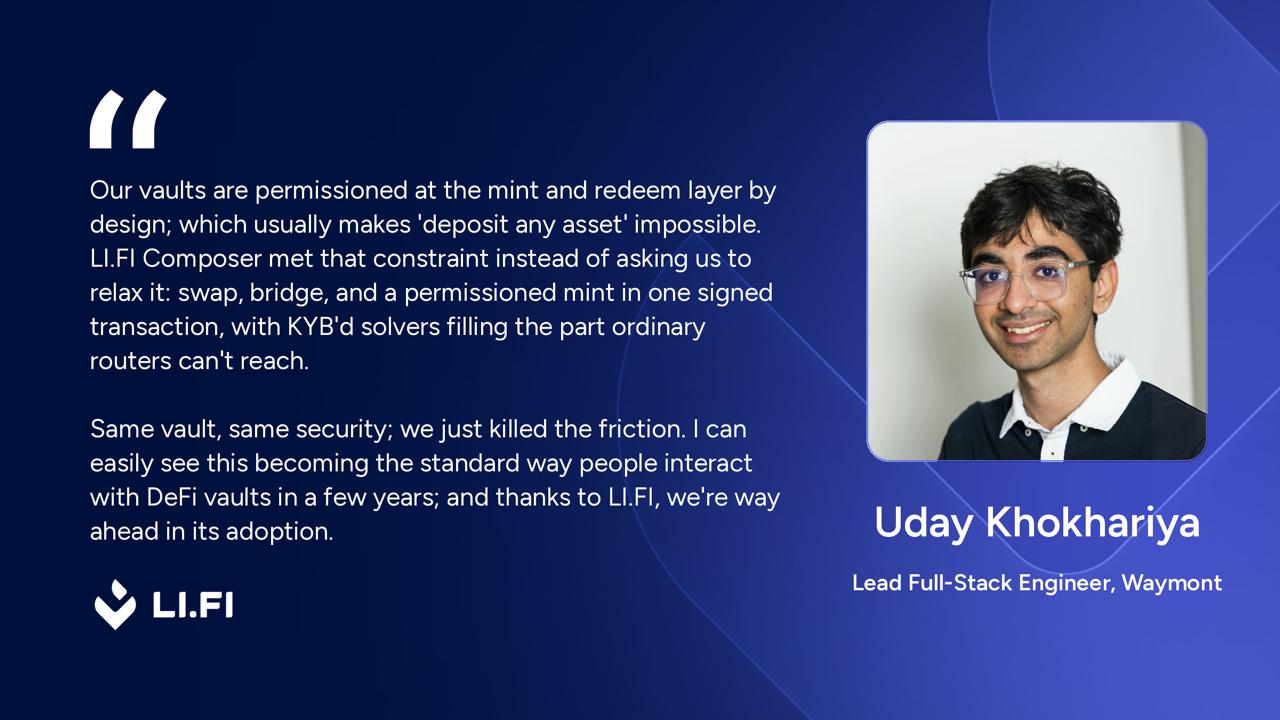
Royco's vaults are permissioned at the mint and redeem layer by design, only whitelisted parties can create or retire vault inventory. It's what keeps the vaults legible to risk committees and compliant venues. It's also exactly the thing that usually makes "deposit any asset" impossible: you can't just swap on the open market and walk in.
Any-asset Deposits & Withdrawals into Royco Vaults
On the vault's deposit panel, you pick from thousands of tokens across Ethereum, Arbitrum, Avalanche, and Base. LI.FI swaps or bridges whatever you bring into the asset the vault expects and deposits it in a single flow; you receive vault shares (srRoyUSDC) at the end. Withdrawing runs the same path backwards, out to whatever asset you want. The panel says it plainly: swapping via LI.FI.
Hold ETH on Arbitrum, end up in a USDC vault on Ethereum — in one go, without ever leaving the page.
Under the hood
LI.FI Composer handles the multi-step path as one transaction. It takes the token you're depositing: swaps, bridges or occasionally wraps it into the asset the vault expects, and deposits it: bundled into a single signature, with the route and price impact shown before you commit. The withdrawal reverses it: redeem, then route out to your chosen asset.
That covers the routing. The harder half is the vault's permissioning.
Why permissioned vaults are the hard part
Most routers can only do the open-market half: swap token A for token B wherever there's liquidity. They can't complete an order that ends in minting or redeeming a vault token only whitelisted parties are allowed to touch. For institutional-grade, compliance-sensitive yield, which is the whole point of Royco's tranched, risk-committee-friendly vaults, that permissioning is a feature, not a bug. It's also where ordinary any-asset access dies.
LI.FI clears it with KYB'd solvers: solvers in LI.FI Intents that have completed KYB checks and are whitelisted to fill permissioned mint and redeem. It comes from LI.FI's intent-based execution, and it plugs into the same Composer flow: so a deposit that needs fresh vault inventory still resolves in one step, filled by a solver the vault actually trusts.
One vault now, built for the platform
Senior Royco USDC Vaults went live with the deposit flow streamlined into a one-click action for users powered by LI.FI Composer. But, the LI.FI Composer integration in Royco isn’t limited to a single vault, it’s the rails for how capital moves in and out of Royco Dawn, and the same any-asset path extends to more vaults as they go live.
The vault stays as particular as it should be about risk. It just stops being particular about how you arrive. The asset you happen to be holding is no longer a prerequisite for the yield you want.
Bringing any-asset yield to your product?
LI.FI Composer turns multi-step, cross-chain deposits and withdrawals into a single signed transaction, and its KYB'd solvers reach permissioned venues that ordinary routers can't.
Get started:
Explore the documentation: https://docs.li.fi
Reach our team: https://li.fi/contact-us/
Disclaimer:
This article is only meant for informational purposes. The projects mentioned in the article are our partners, but we encourage you to do your due diligence before using or buying tokens of any protocol mentioned. This is not financial advice.