Circle’s Cross-Chain Transfer Protocol -- CCTP Deep Dive


The Origins of CCTP
Circle has always had a multi-chain view of the ecosystem, which is evident in the launch of USDC on different chains over the past few years. Originally, USDC launched on Ethereum in 2018 and expanded to other chains like Algorand and Solana as early as 2020, much before the 'multi-chain narrative' had taken shape in the ecosystem. Since then, Circle has launched USDC on several chains, including Avalanche, Stellar, Tron, Hedera in 2021, Flow in 2022, Arbitrum in 2023, and is making headway on its plans of launching USDC on Optimism, NEAR, Statemint and Cosmos via Noble. Circle's strong commitment to multi-chain expansion arises from their belief that each blockchain harbors the unique potential for innovation and distinct customer experiences. Thus, by positioning USDC as an omnichain digital dollar, Circle aimed to establish USDC as a ubiquitous presence across chains.
As mentioned above, numerous lock and mint USDC bridging solutions soon emerged and consequently ended up fragmenting liquidity in the form of wrapped assets. Remember, on Solana alone, there are 11 different wrapped versions of USDC, leading to liquidity fragmentation and causing confusion among developers regarding which version to utilize. Circle identified an opportunity to address the challenges of liquidity fragmentation and removing bridge risk while ensuring the fungibility of USDC on all chains.
Circle actively engaged with the crypto ecosystem and sought feedback from key projects across chains. The response was positive, with stakeholders expressing their willingness to adopt a solution that could provide a fungible USDC experience on different chains. As a result, Circle decided to launch Cross-Chain Transfer Protocol (CCTP), a permissionless onchain protocol for moving USDC natively across chains. CCTP enables a standardized and fungible USDC experience for developers building on multiple chains.
How it Works – Transaction Lifecycle
CCTP is low-level infrastructure for dApps, wallets, bridges, and messaging platforms to build on top of. End-users, "the normies", do not need to interact with CCTP directly. Instead, Circle built CCTP to be accessed by dApp frontends. In other words, CCTP is a tool that crypto developers can use to move USDC natively for their users and simplify UX.
CCTP's design is best understood by breaking down the transaction lifecycle into four parts:
Part 1 – Transaction Initiation (on Source Chain)
User initiates the transaction on the source chain (Chain A) by depositing native USDC into the dApp that has integrated CCTP. The user also provides the recipient wallet address on the destination chain.
Part 2 – dApp Burns Native USDC (on Source Chain)
The dApp facilitates the burn event of the specific USDC amount on the source chain.
Part 3 – Circle Verifies the Burn Event (on Source Chain)
Circle observes and attests to (verifies) the burn event on the source chain. The dApp sends a request to Circle to obtain the attestation, gaining authorization for minting the specified USDC amount on the destination chain.
Part 4 – dApp Mints Native USDC (on Destination Chain)
Using the obtained attestation, the dApp initiates the minting process for USDC. The specified USDC amount is minted on the destination chain (Chain B) and sent to the recipient wallet address.
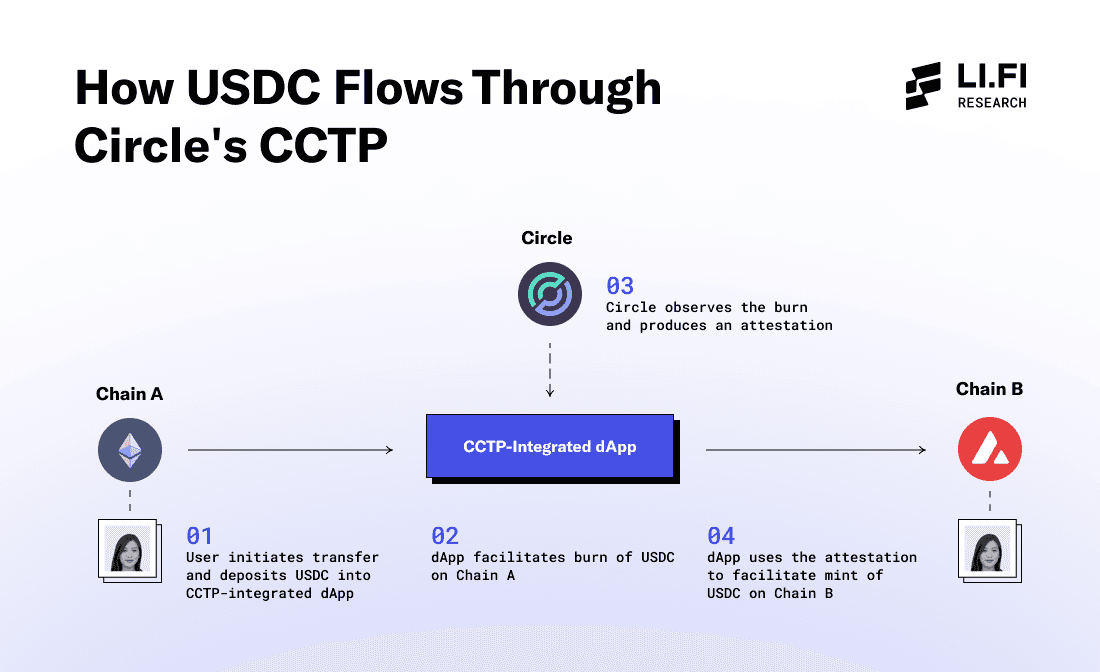
CCTP Transaction Lifecycle
Trust Assumptions
The following trust assumptions are made in CCTP's transaction flow:
1) Dependence on Circle for validating transfers
The burn event of USDC on the source chain must be verified by Circle's attestation service in order to authorize minting of USDC on the destination chain. Thus, user funds are secured by Circle accurately verifying the authenticity of each CCTP transaction.
2) Operational uptime
The end-to-end transaction flow for CCTP relies directly on Circle's attestation service. Therefore, any uncertainties surrounding Circle's operations can potentially result in temporary disruptions or delays in facilitating cross-chain transfers through CCTP.
Supported Networks & Adoption
Circle's CCTP is currently live on 13 blockchains: Algorand, Arbitrum, Avalanche, Base, Ethereum, Flow, Hedera, NEAR, Noble, OP Mainnet, Solana, Stellar, and TRON – with more native integrations expected this year and beyond. CCTP is supported by:
Bridge SDKs – Axelar, Celer, Hyperlane, LI.FI, Multichain, Router, Socket, Wanchain, Wormhole.
Bridge Apps – cBridge, Multichain, Voyager, Wanchain, Jumper, Bungee.
Wallets – MetaMask
Others – CCTP is also supported by several dApps and wallets that have integrated the SDKs of the service providers mentioned above.
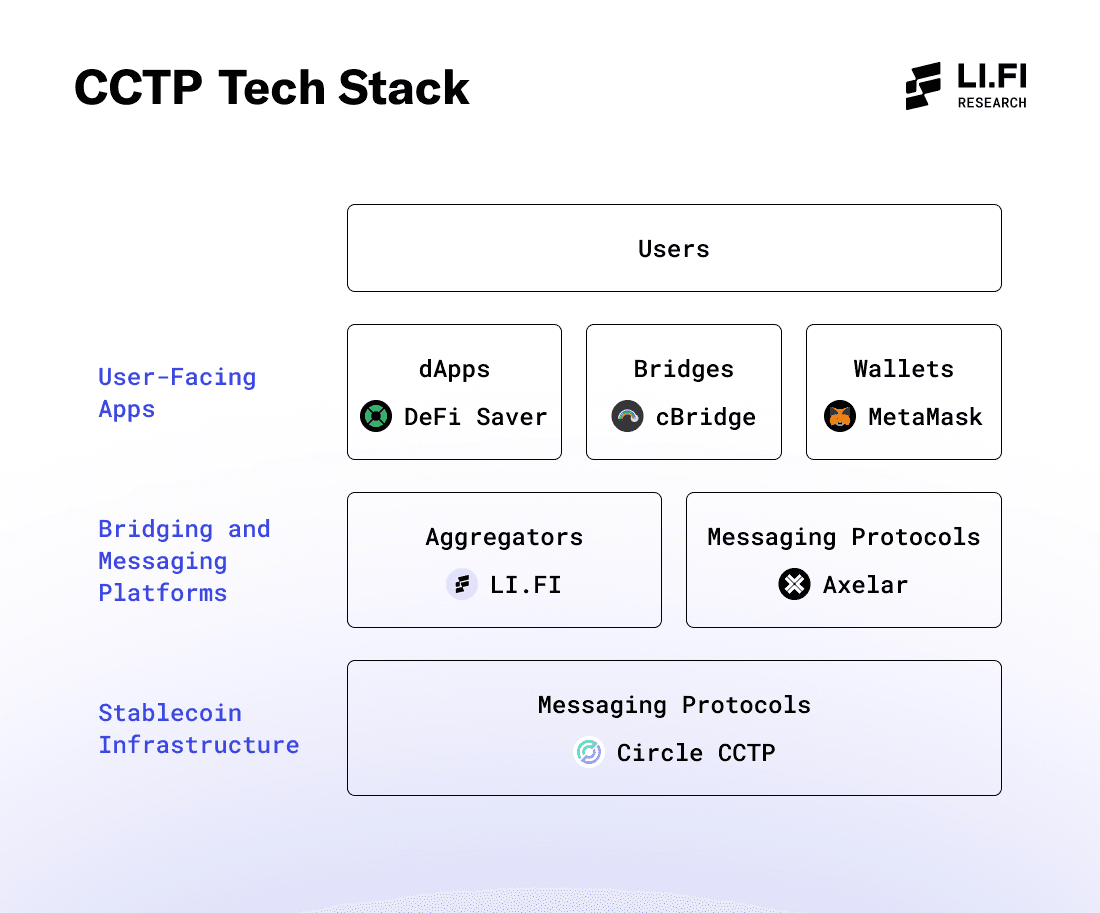
This framework is primarily based on the work by Circle in the CCTP marketing material. Within this framework, each layer relies on the layers beneath it to provide essential functionality.
Resources
You can learn more about Circle's CCTP through the following resources:
Disclaimer:
This article is only meant for informational purposes. The projects mentioned in the article are our partners, but we encourage you to do your due diligence before using or buying tokens of any protocol mentioned. This is not financial advice.