A More Intentional Ethereum: LI.FI Intents and the Open Intents Framework

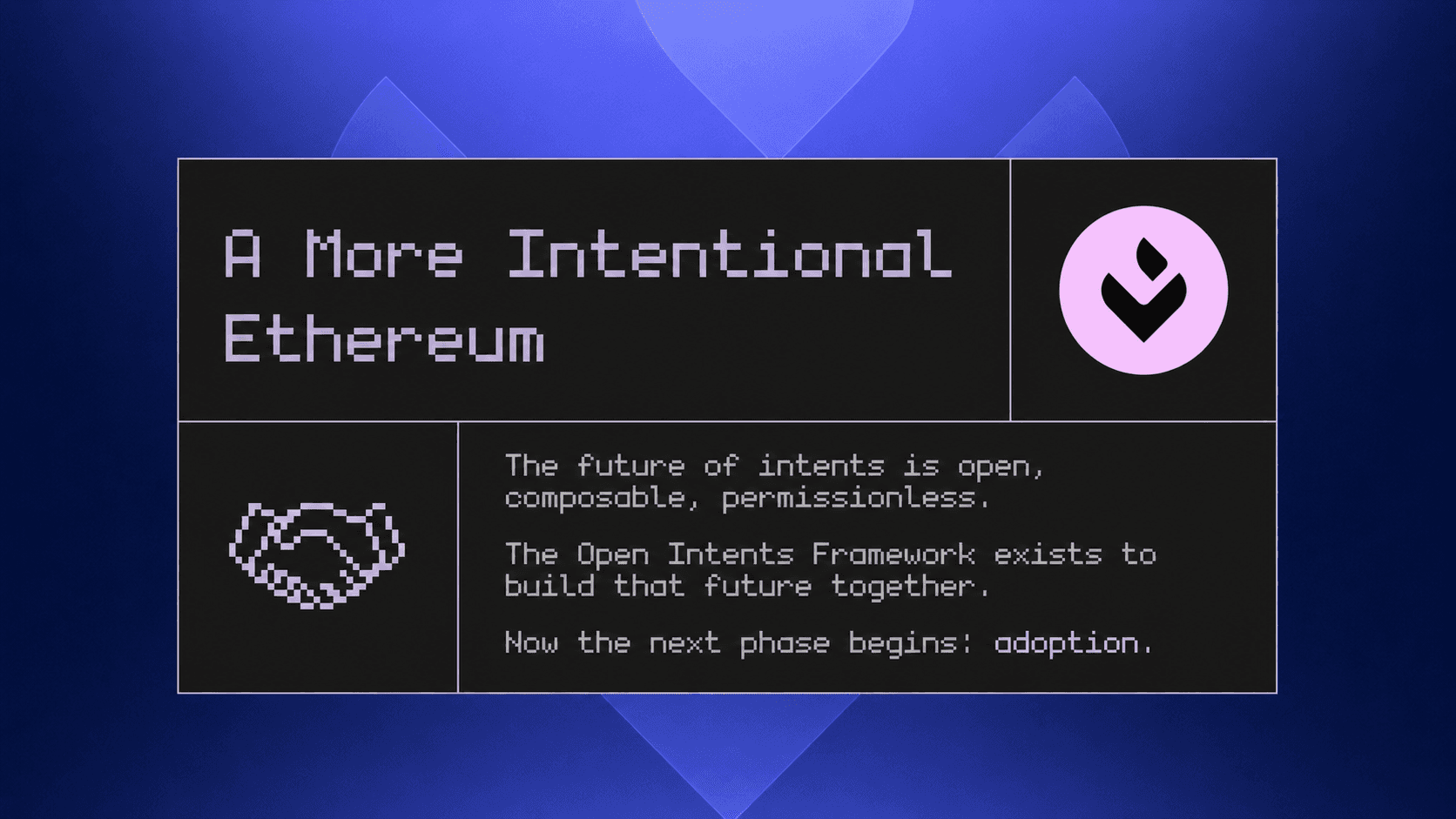
Today we're launching LI.FI Intents - a modular, full-stack execution engine that fulfills orders through a network of professional solvers, competing to provide the best execution, built on the reference contracts of the Open Intents Framework (OIF). LI.FI Intents is the OIF, in production, at scale.
LI.FI Intents x Open Intents Framework
For all intents and purposes, intents have become the go-to design pattern for how trades, transfers, and cross-chain actions get settled onchain. Market-maker-style fills, tight spreads, fast execution, offering a UX that finally feels appropriate for internet-native finance.
The work that’s left is more structural to intents, answering the tough questions like: what does the intent stack need to look like for the next ten years of onchain finance to be built on top of it?
That question has only one defensible answer. The stack has to be open. It has to be modular. It has to be configurable down to the layer that matters for the application using it. It should provide optionality to the teams building on it, and not lock them into proprietary standards.
This is the bet behind the Open Intents Framework (OIF), the public-good initiative led by the Ethereum Foundation, with contributors including LI.FI, OpenZeppelin, Wonderland, Uniswap Labs, Hyperlane and more than 30 other teams. And it is the bet behind LI.FI Intents, which is the implementation of what the OIF stands for, in production, at scale.
Most standards and frameworks in our industry don’t go anywhere. Ghost githubs, silent working groups, and no adoption. The OIF is different. LI.FI Intents launches today on the OIF reference contracts. The two are not parallel implementations. They are the same stack, architecturally and in the foundational contracts they’re built on. The OIF guiding the design principles' intents must be built on, LI.FI Intents operating it in production, with a deep, competitive solver network and the distribution of 1000+ enterprise integrations behind it. LI.FI Intents is the OIF, in production, at scale.
This article is about why that matters, and what it unlocks for anyone building intent-based applications.
The Problem with Intents
Intents are an incredibly declarative primitive. They are reshaping how apps are built and how users interact with blockchains. But the tooling for building intent-based applications hasn’t kept pace with the idea itself.
Historically, intent stacks have been too rigid in design:
1. they force every application into a single, shared execution model – a one-size-fits-all template that breaks down for more complex use cases.
Real-world assets are a clear example: as stocks, bonds, and other instruments move onchain, apps need solvers who are permissioned to access and market-make these tokens directly. Without that, developers are stuck relying on a generic solver set that simply can’t fulfill RWA flows.
2. If instead a team wants to build its own intent solution, they are required to rebuild the whole stack from scratch. These teams inherit a long list of unsolved sub-problems: how to express orders, how to bootstrap a solver network, how to handle cross-chain settlement, how to verify fills, how to manage the off-chain matching layer. Months of engineering disappear into infrastructure that doesn't differentiate the product.
Solving these problems requires open standards and shared infrastructure. That is the OIF's purpose.
Open Intents Framework (OIF)
The core thesis of the OIF is Open Intents: improving the cross-chain user experience while maintaining freedom and minimising trust for teams building with intents.
The OIF is shared infrastructure for the industry built on the belief that if every team has to make their own choice on how an intent is expressed, settled, and verified, the ecosystem fragments. If those choices are encoded as modular components against a shared standard, the ecosystem benefits from each other’s work and progresses faster.
Thus, the OIF is structured around composable layers that gives teams that freedom to choose and customize. And the framework comes with production-ready, MIT-licensed smart contracts (oif-contracts), an open-source Rust solver (oif-solver), and standard interfaces for getting quotes and submitting orders (oif-specs), so teams can access shared resources.
For builders, the practical consequence is significant. You are no longer choosing between using a closed intent network and building the entire stack yourself. You configure the stack against an open standard, plug into a competitive solver marketplace, and ship.
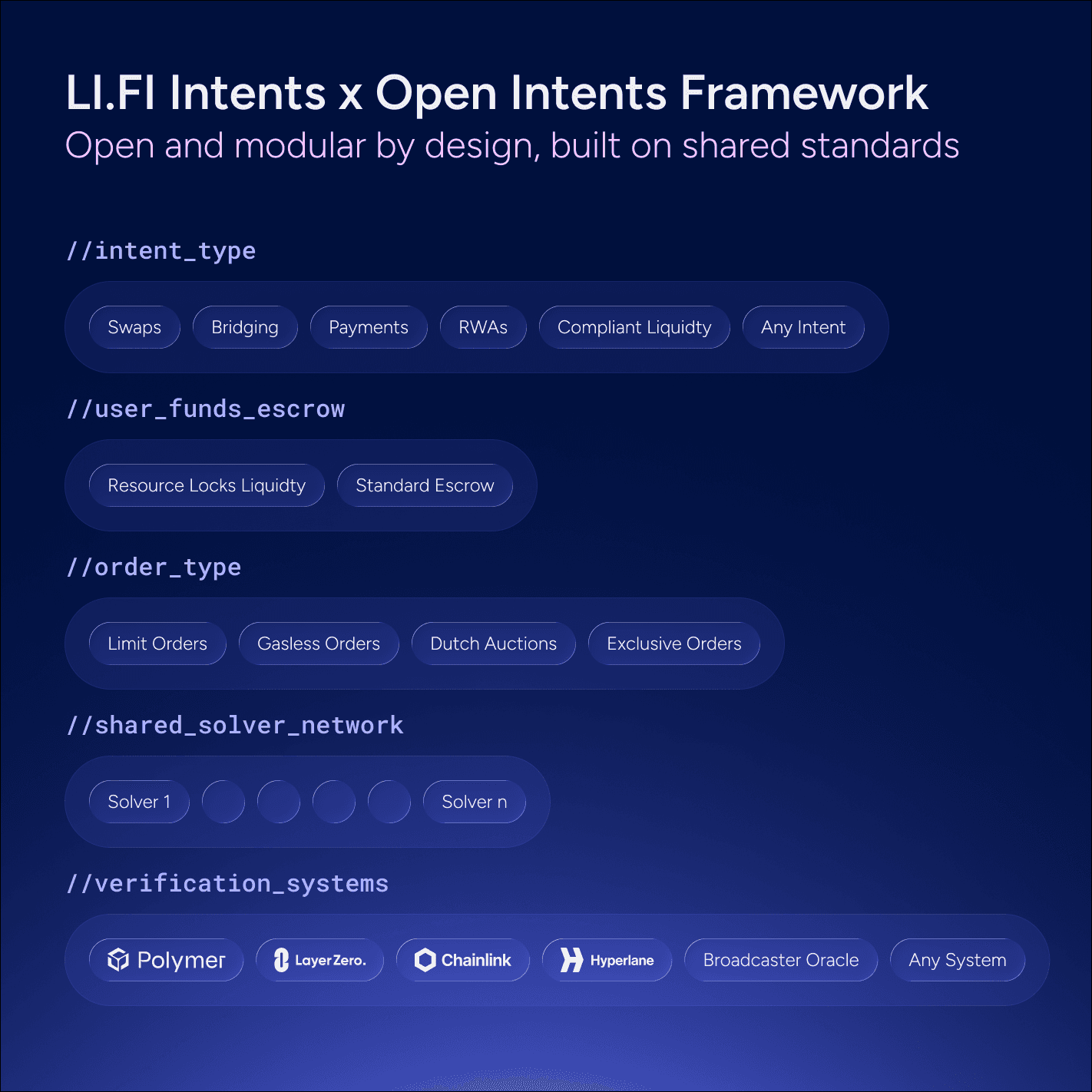
Here’s what that flexibility looks like in practice:
Intent Type – Define any intent use case like swaps, bridging, cross-chain swaps, payments
User Funds Escrow - Define how the flow of user funds should take place (escrow, resource locks.) to match your product’s needs.
Order Type – Choose how value moves by supporting any order type (limit order, gasless orders, auctions) depending on your use cases.
Solver network - Tap into a shared solver network which comes with shared tooling (like resources around ERC-7683) for the solvers, meaning it’s easier for everyone to participate in the network.
Verification System – Plug into your preferred settlement mechanism, from interop protocols to simpler oracle setups to highly trust-minimized solutions like the Broadcaster oracle, depending on your security preferences.
LI.FI Intents is the OIF, in Production
LI.FI Intents is built on the OIF reference contracts and is fully compatible with the OIF intent system. The architecture of LI.FI Intents mirrors the OIF's, because it is the OIF's.
LI.FI Intents adds what’s missing from most standards in this space: adoption.
Over $80B in volume, 100M+ transfers, and 1000+ integrations have flowed through LI.FI's infrastructure to date. That orderflow is now available to OIF-compatible solvers from day one. A solver who integrates the OIF integrates one of the largest orderflow sources in crypto. The flywheel: orderflow attracts solvers, solver competition tightens prices, best prices attract more orderflow, and now it starts spinning at scale for the OIF.
The Ethereum Foundation and the OIF coalition designed the framework. LI.FI is operationalizing it at scale. Every other team building on the OIF benefits.
Build with LI.FI, Build with the OIF
The OIF lowers the cost of building an intent-based application from months to days. LI.FI Intents lowers it again by making the deepest existing orderflow available at the moment of integration.
If you are building stablecoin payments, an RWA front-end, a regulated fintech product, a wallet with cross-chain UX, or a new application-specific intent product entirely, the building blocks exist, they are open, and they are deployed.
LI.FI Intents docs: docs.li.fi/lifi-intents
Open Intents Framework: openintents.xyz
The next decade of onchain UX runs on intents. The infrastructure underneath it should belong to everyone. That is what the OIF is for, and it is why LI.FI Intents is built on it.
If you're building, talk to us. And if you want to contribute upstream — to the contracts, the solver, the specs, the OIF repos are open.
We're building it all, one intent at a time, in the open.
Disclaimer:
This article is only meant for informational purposes. The projects mentioned in the article are our partners, but we encourage you to do your due diligence before using or buying tokens of any protocol mentioned. This is not financial advice.